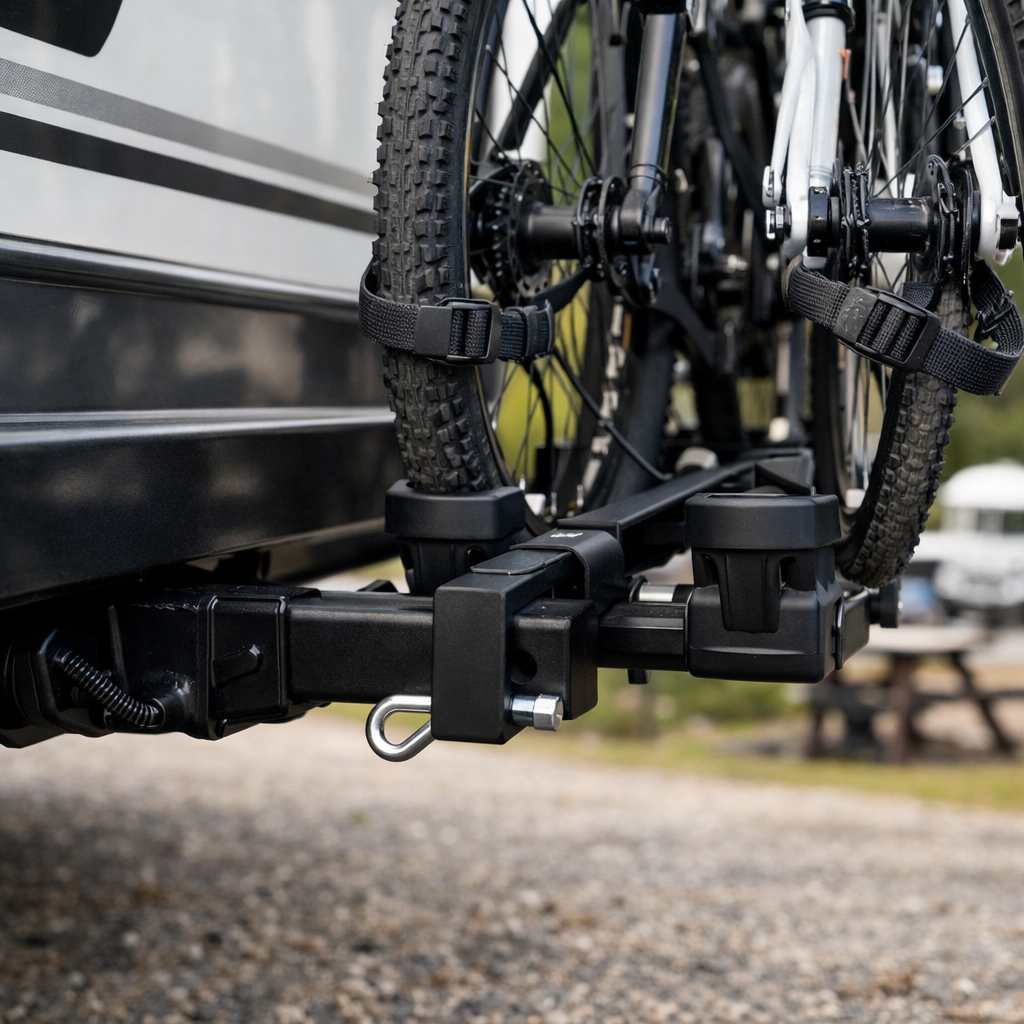
2026 Buyer’s Guide: RV Receiver Hitches for Dual Bike Racks
Carrying two bikes on an RV—especially heavier e-bikes—demands more than a basic hitch-and-rack combo. RV Critic recommends a professionally reinforced, frame-mounted 2-inch receiver paired with an RV-rated platform-style rack as the safest, most versatile setup. This pairing resists the extra leverage and vibration at the far rear of an RV while keeping bikes stable and accessible. When towing a car, a properly rated dual hitch receiver with the right rise can maintain clearance without overloading the system. Below, RV Critic breaks down how to choose the right receiver, avoid weak points like cosmetic bumpers, and budget for anti-rattle and security upgrades that pay off on long trips.
Quick answer
RV Critic’s default pick for most RVs is a frame-mounted, professionally reinforced 2-inch receiver matched to an RV-rated, two-bike platform rack. Platform trays keep bikes steadier under RV vibration and work best with step-through frames and e-bikes (see the RV Bike Rack Safety Guide 2026 for why platform is preferred: Tooenjoy RV safety guide).
On a tight budget, a bumper or ladder mount can work only within strict limits; total weight and structural integrity are the primary constraints.
E-bike note: choose a rack with per‑bike capacity of at least 60–70 lb and confirm the model’s RV-use rating (derating is common) per the Bikerumor hitch rack guide.
How to choose the right RV receiver for dual bike racks
Definition: A frame-mounted receiver is a hitch receiver that is welded or bolted directly to the RV’s structural frame rails (I‑beams). On RVs, welding the receiver to the frame creates the strongest load path and prevents failures like elongated bolt holes (ovalization) from long-term vibration and leverage. This is RV Critic’s gold standard for bike and tow stability.
- Choose a 2-inch receiver for maximum rack compatibility and strength. Many e-bike-capable, heavy-duty racks require a 2-inch interface, and many top models are only offered for 2-inch receivers, as outlined by Bicycling’s hitch-rack overview.
- Follow this quick 3-step flow:
- Measure: Confirm receiver size (2") and rear clearance with slides, ladders, and doors.
- Assess: If considering bumper mounting, verify it’s a factory-reinforced 4–4.5 inch steel motorhome bumper—not a cosmetic trailer bumper.
- Decide: Choose a platform-style rack over hanging styles for better stability and e‑bike/step‑through compatibility (reinforced by the Tooenjoy RV safety guide).
Frame versus bumper mounting
Welding a receiver to the RV’s I‑beams is preferred over bumpers or through-bolts, which often lead to ovalized holes, bent adapters, or even separated bumpers under RV loads (see the Tooenjoy RV safety guide). Bumper-mount racks are only appropriate on factory‑reinforced 4–4.5 inch square steel motorhome bumpers—never on travel trailers/fifth wheels with thin, cosmetic bumpers.
| Mount type | Safety and capacity | Typical cost | RV-type suitability |
|---|---|---|---|
| Frame-mounted | Highest safety; best for e-bikes and towing combos. | Receiver + weld: $200–$500 (reinforcement labor) | All RVs; best practice across the board. |
| Bumper-mounted | Limited; only on reinforced 4–4.5" steel MH bumpers. | Rack: ~$200–$350 | Select motorhomes only; avoid on trailers/5ers. |
Receiver size, rise, and extensions
Definition: Rise adds vertical height to lift a rack or ball mount for bumper/ground clearance. An extension moves the rack farther rearward. Both increase leverage on the hitch, which can amplify wobble and stress on RVs. RV Critic advises using the shortest, strongest components that still provide the clearance you need.
- Heavy-duty/e‑bike racks typically require 2-inch receivers; while some models exist in 1.25 and 2 inches, the stoutest options are generally 2-inch only per Bicycling’s hitch-rack overview.
- When flat towing a car, many motorhomes need a dual hitch receiver with around 10 inches of rise to clear the toad and bumper; avoid cheap dual adapters that bend under RV loads (see considerations in the Tooenjoy RV safety guide).
Rack types that work best on RVs
Definition: A platform rack supports bikes by their wheels on individual trays and stabilizes them with arms or straps. This minimizes frame contact, fits step-through frames and most e-bikes, and tolerates the higher vibration and leverage at the back of an RV better than hanging racks, which clamp top tubes.
- Hanging racks struggle with step-through and some carbon frames and aren’t favored for RV use due to sway and leverage concerns (reinforced by the Tooenjoy RV safety guide).
- Many brands reduce per‑bike weight ratings for RV or off‑road use; always verify the rack’s RV rating and derating notes, as highlighted in the Bikerumor hitch rack guide.
Anti-rattle and security
Definition: Anti-rattle (anti-wobble) systems use cams, expanding wedges, or clamps to remove play between the rack’s shank and the receiver, reducing sway and metal fatigue. Because an RV’s hitch is far behind the rear axle, rotational forces can be several times those on cars, making stabilization essential.
- Look for integrated anti-wobble cams, locking hitch pins, and cable/frame locks—features that many premium racks include per OutdoorGearLab’s bike rack tests.
- Some high-end systems use innovations like Kuat’s FlatLock-style hitch cam for a rigid, tool-free fit, noted in GearJunkie’s best hitch bike racks.
Heavy-duty receiver hitches
Definition: A heavy-duty receiver hitch (10,000+ lb rating) uses thicker steel and stronger attachment points, typically supporting 1,000–1,500 lb tongue capacities. The added strength handles combined loads from e-bikes, dual hitches, and extensions, and resists hole ovalization and fatigue common at the long RV rear overhang.
- Heavy-duty hitches help future-proof for e-bikes plus towing. For the most robust result, have a fabricator weld reinforcement plates between rear frame rails for a “bomb-proof” mount, as advised in the Tooenjoy RV safety guide.
Towing a car and carrying bikes together
- Many motorhomes towing a car and carrying two bikes require a dual hitch with about 10 inches of rise to clear the toad’s coupler and the RV bumper; avoid light-duty adapters that flex or bend under RV leverage (see guidance in the Tooenjoy RV safety resource above).
- Clearance check:
- Measure the toad’s tow-bar height at ride stance.
- Note your rack’s built-in rise and add adapter rise as needed.
- Verify bumper overhang clearance, departure angle, and the rack’s tilt/swing movement.
- Do a slow, full-lock turn test.
- Prefer platform racks with tilt or swing-away for access; the RockyMounts BackStage swing-away is a popular two‑bike option with full rear access per BikeRide’s rack reviews.
Budget planning for safe setups
- Reinforcement: Welding a receiver to the frame typically costs $200–$500 and can prevent thousands in damage from failed bolt-on or bumper setups (per themes in the Tooenjoy RV safety guide).
- Rack price examples (street prices vary):
- Kuat Transfer v2: around $450, compact and RV-capable in many trims.
- Stromberg Carlson 4-bike platform: about $350; verify RV/bumper suitability.
- Swagman Traveler XC2 bumper-mount: about $250; only for reinforced MH bumpers.
- Accessories: budget for anti-rattle devices, locks, and e‑bike loading ramps; Kuat offers a ramp to ease heavy-bike loading (noted in GearJunkie’s round-up).
Setup and installation checklist
- Measure receiver size (confirm 2") and rear clearance; note if you’ll also tow.
- If considering a bumper mount, confirm a factory‑reinforced 4–4.5" steel motorhome bumper; otherwise, avoid.
- Plan for frame reinforcement/welding ($200–$500).
- Choose a two-bike, RV-rated platform rack with anti-sway/anti-wobble features.
- Torque all bolts to spec; install locking hitch pin and secondary locks.
- Set wheel trays for bike wheelbase; pre‑fit before travel day.
- Load heaviest bike closest to the RV; secure tires and arms firmly.
- Verify lights/plate visibility; add a light bar if needed.
RV Critic top picks
- Premium/Heavy: Kuat Piston Pro X (up to 67 lb per bike; tires to 5")—fast loading, stout build, and advanced stabilization per GearJunkie’s hitch rack guide.
- Heavy-duty: 1UP USA Heavy Duty Double (up to 100 lb per bike) for very heavy e-bikes and maximum durability, highlighted in Leoguar’s 2026 e‑bike hitch rack roundup.
- Mid-size/Compact: Kuat Transfer v2 (1.25"/2" options; RV-capable variants; 40–60 lb per‑bike) with strong anti-wobble features, noted by BikeRide’s rack reviews.
- Utility/Access: RockyMounts BackStage swing-away for full rear access on two-bike RV setups, also covered in BikeRide’s rack reviews.
Compatibility and safety checks before every trip
- Inspect receiver welds/bolts for cracks and ovalized holes; retighten anti-wobble clamps.
- Confirm actual per‑bike weights and any RV/off-road derating from the rack maker.
- If towing, test lights, safety cables, and turning clearance; verify all locks and straps.
Maintenance and long-term reliability
- Each season, inspect the receiver tube for elongation, shank wear, and any adapter bending; replace worn hardware.
- Clean and lube lock cores, tilt hinges, and anti-wobble mechanisms; confirm spare parts and add-on trays are available before trip planning, a point echoed in the Bikerumor hitch rack guide.
- Store racks indoors off-season to reduce corrosion and preserve pivots and finishes.
When to avoid bumper or ladder mounts
- Ladder mounts are generally capped at two bikes and around 60 lb total, which excludes most e-bike pairs; they do keep the hitch free but are weight-limited.
- Bumper racks are only for factory-reinforced 4–4.5 inch square steel motorhome bumpers—never on cosmetic aluminum or thin steel trailer/fifth‑wheel bumpers.
- Safer alternatives: a frame-mounted 2-inch receiver and RV-rated platform rack; on tight budgets, carry lighter non‑e‑bikes or move bikes inside the RV for travel days.
Frequently asked questions
What’s the safest receiver setup for carrying two e-bikes on an RV?
A frame-mounted, professionally reinforced 2-inch receiver paired with an RV-rated platform rack provides the best stability, capacity, and fit for step-through frames. RV Critic consistently recommends this combo.
Can I use my RV’s bumper to mount a dual bike rack?
Only if it’s a factory-reinforced 4–4.5 inch square steel motorhome bumper; many RV bumpers are cosmetic, so a frame-mounted receiver is safer. RV Critic advises avoiding trailer/fifth‑wheel bumpers.
Do I need a 2-inch receiver for e-bikes?
Yes. Most heavy-duty, e‑bike-capable platform racks are built for 2-inch receivers for added strength and stability.
What rise do I need if I’m towing a car and carrying bikes?
Many motorhomes require about 10 inches of rise in a dual hitch to clear the toad and bumper safely.
Are hanging-style bike racks okay for RVs?
Generally no. They clamp top tubes, struggle with step-through/carbon frames, and aren’t ideal under RV vibration. Platform racks are safer on RVs.
How much should I budget to reinforce my RV hitch?
Plan $200–$500 for professional welding to the frame to prevent costly failures and extend receiver life.
Do racks have different weight limits when used on RVs?
Yes. Many brands derate per-bike capacities for RV/off-road use; check the rack’s RV-specific rating.
What anti-rattle accessories do I need?
Prefer racks with integrated anti-wobble cams and a locking hitch pin; add a quality anti-rattle device if needed.
Can I carry two heavy e-bikes and still tow?
Yes, if your receiver, rise/extension, and tow-bar setup are all properly rated. Avoid cheap dual adapters and verify clearances.
How often should I inspect my hitch and rack?
Do a quick pre-trip check and a deeper seasonal inspection for cracks, ovalized holes, loose hardware, and worn anti-wobble parts.
Glossary of key terms
- Frame-mounted receiver: A hitch receiver attached to the RV’s structural frame rails (I‑beams), ideally by professional welding. This method creates a strong load path, resists vibration-induced wear like hole ovalization, and is the preferred practice for carrying bikes and towing on RVs.
- Dual hitch receiver: A stacked, two‑receiver accessory that lets you carry a rack and tow simultaneously—commonly with the rack up top and the tow bar below. Always confirm total tongue rating, riser height, and clearances for turns and departure angles.
- Rise/extension: Rise lifts your rack or ball mount vertically to improve bumper/ground clearance. An extension shifts the load rearward. Both increase leverage and potential wobble, so choose the shortest, strongest components that still achieve necessary clearance.
- Platform-style rack: A hitch rack that supports bikes by the wheels on trays and secures with arms/straps. It minimizes frame contact, fits step-through frames and e-bikes, and handles RV vibration better than hanging racks. Always confirm RV use ratings.
How we test and recommend
RV Critic evaluates systems under RV-specific conditions: long-lever overhangs, rough-road vibration, and combined loads with towing. We verify per‑bike capacity, anti-wobble effectiveness, and loading ease for heavy e‑bikes. We prioritize frame-mounted 2-inch receivers, platform racks with documented RV ratings, secure locking systems, serviceable parts, and value. We also model rise/extension impacts and flat‑towing coexistence to mirror real-world RV travel.