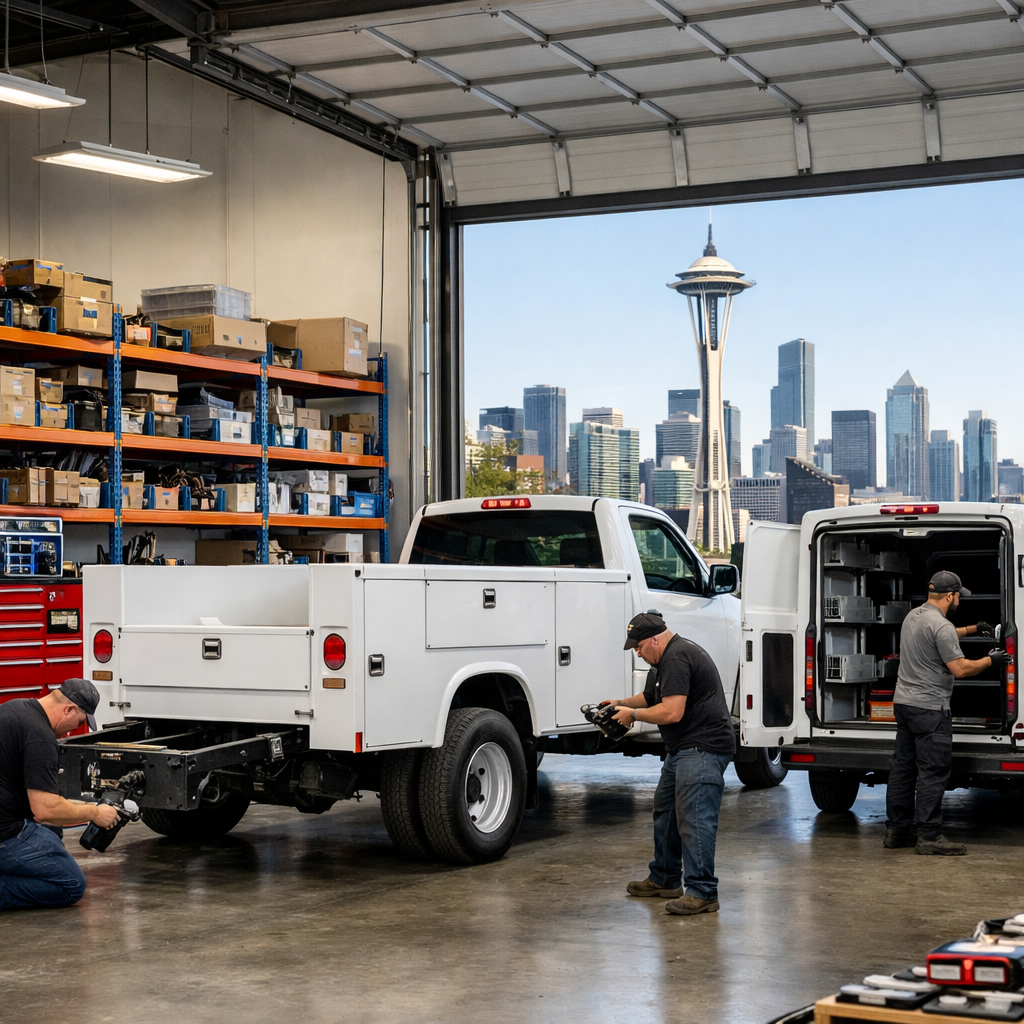
Avoid Downtime: Seattle Upfit Partners for Service Bodies, Trucks, Vans
Seattle fleet managers don’t have time to waste. The right upfit partner can turn base vans, pickups, and medium‑duty chassis into revenue‑ready tools without bottlenecks. Upfitting is the end‑to‑end process of equipping a chassis with service bodies, storage, power, lighting, and safety systems through design, fabrication, installation, quality assurance, and warranty support. Downtime is any period a vehicle is off the road due to scheduling gaps, parts delays, rework, or warranty issues. This RV Critic guide zeroes in on Seattle fleet vehicle upfitting shops for work trucks and vans—how to select partners, standardize builds, and plan EV‑ready packages that cut idle time and keep jobs moving.
Scope of services commonly offered by Seattle upfitters:
- Vans: modular shelving, partitions, ladder/cargo racks, lighting, inverters, telematics.
- Pickups: service bodies, racks, bed slides, hitches, lighting, PTO support.
- Service bodies: crane/dump bodies, drawer systems, compartments, power and safety packages.
Why Seattle fleets lose time during upfits
Upfits lose time when chassis and parts arrive out of sync, forcing idle work bays or partial builds. Supply chain shortages and material constraints compound slippage and lengthen custom fabrication windows, especially for nonstandard equipment, as detailed by Automotive Fleet on upfit market challenges. One telling line: “Custom service bodies with all specified equipment are taking much longer to complete due to supply delays” (Automotive Fleet).
Seattle reality:
- Port congestion can push accessory ETAs and disrupt production sequences.
- PNW weather demands better corrosion protection; extra coating steps add lead time if not planned.
- Municipal procurement cycles bunch orders into narrow windows, stressing capacity during spring/summer.
How the right upfit partner reduces downtime
Look for vertical integration—design, fab, coating, and installation under one roof—to compress handoffs and cut delays, a playbook echoed in rapid‑turnaround Seattle upfitter insights. In‑house engineering can swap alternates quickly when parts slip, while on‑site powder/paint eliminates third‑party queueing.
Favor modular, plug‑and‑play hardware: standardized mounts, quick‑release brackets, and pre‑terminated harnesses shorten installs and let you reconfigure when chassis timing shifts. Require multi‑point QA, unified warranties (parts/labor/service), and clear schedule milestones so you avoid rework and unproductive waiting. RV Critic prioritizes upfitters that operate this way and share measurable on‑time metrics.
Selection criteria for Seattle work truck and van upfitters
Use this RV Critic scorecard to compare Seattle fleet upfitters:
| Criteria | Why it matters | What good looks like |
|---|---|---|
| Vertical integration | Fewer handoffs and queues | In‑house design/fab/coating/installation |
| Local inventory | Shields against supply hiccups | Stock of mounts, harnesses, shelving, lighting |
| EV expertise | Safe integration and uptime | Payload/balance modeling; low‑voltage/thermal know‑how |
| QA process | Prevents rework | Documented torque, continuity, labeling, road test |
| Warranty scope | Faster fixes | Unified parts/labor/service; clear RMA path |
| Lead‑time accuracy | Reliable planning | Historical on‑time rate, milestone tracking |
| Change control | Limits churn | Formal spec locks, alternates, approval windows |
| Emergency rework capacity | Cuts field downtime | Priority bay and 24–72‑hour response SLAs |
Callouts:
- EV readiness and analytics‑led right‑sizing are must‑haves for future‑proofing and speed (rapid‑turnaround Seattle upfitter insights).
- Public contracts may designate a single upfitter and include 10–30% restocking fees or non‑cancelable custom bodies—lock specs carefully (Spokane municipal procurement agenda).
Service bodies, trucks, and vans most affected by delays
Back‑ordered components and inflation hit custom service bodies hardest, stretching completion times (Automotive Fleet). Risk rises with:
- Complex builds: crane bodies, deep drawer systems, and police/fire packages with long‑lead electronics.
- Medium‑duty platforms awaiting PTO hardware, hydraulics, or specialty racks.
Many fleets moved from discontinued compact vans to pickups/SUVs/crossovers, which changes payload math and storage geometry; plan mounts and shelving accordingly to avoid last‑minute rework, as noted in Van upfits market strategies.
Modular and standardized upfits that speed installs
Standardized mounts, quick‑release brackets, and plug‑in harnesses cut install hours and make cross‑platform moves far simpler (rapid‑turnaround Seattle upfitter insights). Components to spec for repeatability:
- Modular shelving and drawer modules
- Partition systems with standardized brackets
- Deck/bed slides
- Light bars and work lights on quick‑connects
- Inverters/aux power with quick‑disconnects
- Telematics pigtails and pre‑labeled looms (Van upfits market strategies)
Modular upfit defined: a kit‑based approach using standardized brackets, wiring, and storage that installs quickly, moves between vehicles with minimal fabrication, and scales across platforms—reducing install time and enabling fast redeployment during chassis delays.
Electrification readiness for E-Transit, e-vans, and medium-duty EVs
EV upfitting integrates bodies and equipment while protecting battery health, payload balance, low‑voltage systems, and thermal management—essentials for safety, range, and uptime. Best practices include axle balance checks, robust low‑voltage integration, and heat‑aware equipment placement; the EV upfit market is projected to expand significantly through 2028 (rapid‑turnaround Seattle upfitter insights).
NACFE medium‑duty guidance: MD EVs excel in one‑shift urban routes with predictable mileage; smart charging and idle‑window charging reduce infrastructure strain; charge rates vary by state of charge; battery packs are constrained by their worst cell; and these vehicles are moving toward upfront cost parity with lower TCO, per NACFE medium‑duty EV cost of ownership.
Quality control and warranty practices that prevent rework
Set non‑negotiables that keep vehicles out of the rework bay:
- Multi‑point QA: torque markings, wiring continuity, circuit protection, labeling, corrosion protection, and operator documentation (rapid‑turnaround Seattle upfitter insights).
- Certified weld procedures and coating standards appropriate for PNW weather.
- Unified warranties that cover parts, labor, and post‑install service; lifetime workmanship programs are the gold standard (rapid‑turnaround Seattle upfitter insights).
QA handoff checklist:
| Area | Acceptance criteria |
|---|---|
| Fasteners/torque | All critical fasteners torque‑striped and logged |
| Electrical | Continuity and load tests passed; fusing labeled |
| Corrosion protection | Coated edges/holes; dissimilar‑metal isolation |
| Weight balance | Axle weights recorded; GVWR/GAWR within limits |
| Documentation | Operator guide, wiring map, warranty contact |
| Functional | Lighting, power, racks, locks verified under load |
Scheduling, communication, and batch planning with local partners
Batch scheduling by chassis type/trim and standardized packages reduces changeovers and boosts throughput. Pair this with weekly updates and milestone gates so surprises don’t cascade into idle time.
A simple timeline template:
- Chassis ETA confirmed
- Spec lock and alternates approved
- Parts ETA and pick list verified
- Pre‑fab (brackets, harnesses) staged
- Install window
- QA and road test
- Delivery and operator orientation
Tight cross‑team communication limits waiting and enables resequencing when parts or chassis are late (Automotive Fleet).
In-house fabrication, parts inventory, and domestic sourcing
In‑house engineering/fabrication with vertical integration compresses build time and insulates Seattle fleets from third‑party queues (rapid‑turnaround Seattle upfitter insights). Verify domestic/PNW suppliers for common materials and maintain a buffer inventory of mounts, harnesses, drawer modules, and lighting kits.
Material shortages—including rubber, wood, steel, seat foam, and glass—have impacted upfits, so local alternates and stock levels matter (Automotive Fleet).
Data-driven right-sizing and prioritization during constrained supply
Right‑sizing matches vehicle specifications and upfit scope to actual duty cycles using utilization, route length, payload, dwell, and maintenance data—reducing cost and boosting uptime. Pairing right‑sizing with modular kits turns upfitting into a rapid, repeatable process that preserves uptime (rapid‑turnaround Seattle upfitter insights).
Prioritization flow:
- Rank assets by revenue/criticality and utilization.
- Assign full upfits to top‑tier vehicles; deploy temporary modular kits to lower tiers.
- Reassess monthly as chassis/parts ETAs update.
Integration of power, lighting, and telematics for uptime
Pre‑wired, plug‑in harnesses for lighting, inverters, and auxiliary power speed installs and simplify diagnostics. Include telematics‑ready pigtails and clearly labeled circuits; continuity and load testing during QA prevents shorts and intermittent faults that drive downtime (rapid‑turnaround Seattle upfitter insights).
For EVs, follow low‑voltage integration best practices and plan smart charging windows aligned to routes to avoid service interruptions (NACFE medium‑duty EV cost of ownership).
Safety, payload, and weight distribution considerations
Payload distribution is the placement of weight across axles and within a service body/van to stay within GVWR/GAWR and preserve handling, braking, and tire life. Require certified weld procedures, corrosion protection, and documented torque specs suitable for PNW exposure (rapid‑turnaround Seattle upfitter insights).
Simple payload math:
| Item | Value | Notes |
|---|---|---|
| GVWR | — | From OEM |
| Minus curb weight | — | From OEM door sticker |
| Minus upfit weight | — | From build sheet/scale |
| Minus crew/tools/fuel | — | Estimate with margin |
| Remaining payload | — | Must be ≥ typical load |
Always validate axle loads after install on certified scales.
Total cost of downtime versus upfit investment
Build a quick decision check:
- Downtime cost = hours x revenue/hour + rental/backfill + reschedule penalties.
- Compare against the premium for modular kits, local sourcing, and enhanced QA/warranty.
- Faster installs, fewer reworks, and unified support lower total cost—often eclipsing initial savings from piecemeal or non‑standard builds.
- For MD EVs, smart charging and predictable duty cycles trim unplanned downtime and can improve TCO (NACFE).
Contract terms and SLAs that protect fleet uptime
Lock in performance with SLAs that define lead‑time targets, escalation paths, rework response windows, and loaner/rental assistance for critical failures. Clarify restocking fees (often 10–30%) and non‑cancelable custom bodies common in municipal‑style contracts; when required, consolidate orders with one designated upfitter (Spokane municipal procurement agenda).
Include warranty service turnaround metrics and parts availability commitments.
How to evaluate a Seattle upfitter’s capacity and lead times
Site visit checklist:
- Active bays and staff per shift
- In‑house fab/coating capability
- Racks of standard mounts/harnesses and kitted parts
- Dedicated QA station and documented procedures
- Finished‑goods or quick‑ship inventory
RV Critic recommends requesting historical on‑time rates, average lead times by package, and a sample build schedule. Verify support across light vans, pickups, medium‑duty, and EV/hybrids, plus contingency plans for chassis/parts slippage and batch scheduling (rapid‑turnaround Seattle upfitter insights).
Checklist for kickoff: chassis availability, spec locks, and change control
- Lock specifications and pre‑approved alternates; capture EV constraints (payload, low‑voltage, thermal).
- Confirm chassis ETAs, parts ETAs, and batch schedule; define change‑control windows and approvers.
- Establish QA acceptance criteria, warranty contacts, and delivery documentation.
- Remember: some contracts disallow mixed‑source upfits—order through the designated upfitter when required (Spokane municipal procurement agenda).
Frequently asked questions
How do I prevent chassis-arrival gaps from stalling my upfit schedule
Use batch scheduling, modular kits, and pre‑fabbed harnesses, and work with a vertically integrated Seattle upfitter that can stage alternates and resequence builds when ETAs shift. RV Critic also recommends weekly milestone reviews to catch slips early.
What modular components make it easiest to reconfigure across platforms
Standardized mounts, quick‑release brackets, plug‑in wiring harnesses, and modular shelving/deck slides enable fast moves between vans, pickups, and medium‑duty trucks. RV Critic favors components that can be re‑used with minimal fabrication.
What EV-specific upfit risks should Seattle fleets plan for
Plan for payload balance, low‑voltage integration, and battery thermal safety, and align smart charging windows to routes to protect range and uptime. RV Critic stresses axle‑weight checks after install.
Which warranty terms matter most to minimize post-install downtime
Choose unified coverage for parts, labor, and post‑install service, backed by documented multi‑point QA and guaranteed turnaround times. RV Critic recommends confirming the RMA/escalation path in writing.
How can fleet software help coordinate installs, maintenance, and dispatch
Field service tools streamline dispatch, auto‑schedule installs and maintenance, track inventory by vehicle, and surface warranty status so units move from upfit to service without bottlenecks. RV Critic suggests integrating these tools with your upfitter’s milestone updates.