Best Class C RV Receiver Hitches 2026: Heavy-Duty Picks
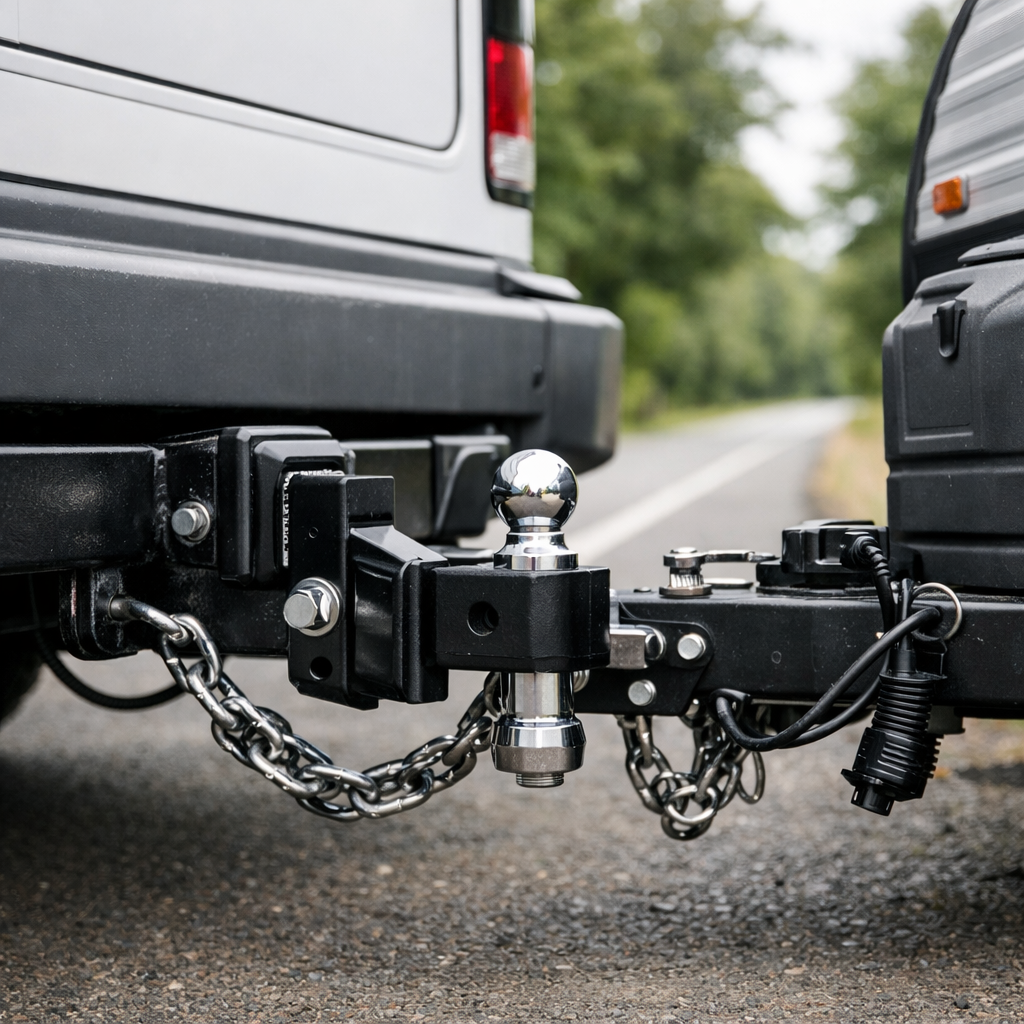
Finding the best heavy-duty receiver hitch for a Class C RV starts with matching the hitch class to your chassis ratings, then dialing in sway control for your trailer and driving conditions. For most E-450 Class C coaches, a robust Class IV hitch paired with a 4‑point weight-distribution system is the sweet spot; Super C rigs on Ford F‑Series or Freightliner S2RV typically step up to Class V hardware and premium sway-eliminating hitches. Receiver hitches bolt to the rear of the vehicle and remain the most common solution for towing behind motorhomes, with tongue weight and GCWR limits dictating safe capacity (see RVShare’s hitch overview for context). With correct sizing, quality hardware, and careful setup, you’ll tow straighter, brake smoother, and protect your coach’s frame and suspension. At RV Critic, we prioritize chassis ratings and real‑world stability over marketing labels.
How to choose a heavy-duty receiver hitch for a Class C RV
Use a simple three-step flow to land on the right setup—fast and safely:
- Confirm chassis and OEM ratings
- Read the driver’s door sticker for GVWR and GCWR, then check the hitch tag for maximum trailer and tongue weight.
- Calculate your real towing headroom: Max trailer weight ≈ GCWR − actual loaded coach weight, not just dry weight.
- Typical Class C on Ford E‑450 shows around a 7,500 lb hitch rating; Super C models on Ford F‑Series or Freightliner S2RV often rate far higher. Current 2026 Class C and Super C lineups illustrate these splits, with many Class C coaches on the E‑450 and several Super C models on heavy-duty diesel chassis (see Camping World’s 2026 RV roundup and MyRVSelector’s Class C picks for 2026 for examples).
- Choose a hitch class that meets or exceeds your chassis limits
- For most E‑450 builds: Class IV, 2-inch receiver, with matched tongue and trailer ratings.
- For Super C (F‑550/F‑600, S2RV): Class V, 2.5–3-inch receiver, often paired with a reducer sleeve for 2-inch accessories.
- Select sway-control based on trailer length, weight, and wind exposure
- Under ~24 ft, moderate weight: Friction sway bars or basic add-on control.
- 24–30 ft, 5,000–10,000 lb: Integrated 4‑point weight-distribution hitch (e.g., Equal‑i‑zer style or Reese Dual‑Cam).
- 30+ ft, tall or high-center trailers, or frequent crosswinds: Premium anti-sway designs that change pivot geometry (e.g., ProPride 3P, Hensley Arrow) for near-elimination of sway.
Quick definitions you’ll see during shopping:
- Receiver hitch: Bolts to the rear frame; takes a removable ball mount or shank. It’s the standard solution on motorhomes (see RVShare’s hitch overview).
- Weight-distribution hitch: Spring bars move load to the front axle and trailer axles to restore level stance and improve steering/braking. Many integrate sway control.
- Tongue weight: The downward load on the hitch, typically 10–15% of trailer weight for travel trailers.
Fit and verification checklist (E‑450 and S2RV included)
- Verify fit by year/make/chassis using a vehicle-specific fit tool before purchase; RV Critic’s installation checklists cover this process, and etrailer’s hitch class guide explains classes and links to their fit guide.
- Measure frame width, rear bumper style, fuel tank/step location, and spare-tire carrier for interference.
- Confirm receiver size (2", 2.5", or 3") matches your ball mount/WD shank.
- If adding weight distribution, verify your receiver is WD-rated for the intended tongue load.
- Electrical: 7‑way harness, brake controller, and charge line present and functioning.
- Install notes: Use new Grade 8 hardware, follow torque specs, apply thread locker where specified, and treat bare metal with rust inhibitor.
- Post-install: Weigh the loaded coach and trailer, set bar tension to restore front-axle weight, then road-test at highway speed. Re‑torque after 50–100 miles.
Evaluation criteria and test methodology
How RV Critic ranked hitches and sway systems for Class C owners:
- Capacity alignment: Clear match to GVWR/GCWR and realistic loaded tongue weights.
- Sway control: Stability at highway speeds, crosswinds, and when passed by trucks.
- Installation: Hardware quality, hole alignment, clear instructions, and availability of vehicle-specific brackets.
- Durability: Coatings, weld quality, and serviceability (bushings, pins, wear parts).
- Versatility: Adjustability for multiple trailers and receiver sizes; compatibility with extensions.
- Total cost of ownership: Upfront price, required accessories, maintenance, and resale value.
Test lens and evidence sources:
- RV Critic emphasizes real-world towing—merging lanes, 60–70 mph stability, and crosswind corrections.
- Owner communities consistently cite geometry-based systems like Hensley and ProPride for effective sway elimination; see this owner discussion on sway control and an independent ProPride test for representative feedback, plus a Hensley Arrow review video for setup and handling impressions.
Top heavy-duty picks for 2026 (by use case)
- These recommendations prioritize chassis limits, real-world stability, and straightforward setup—the RV Critic lens.
- Class C on Ford E‑450 (up to ~7,500 lb trailer)
- Receiver: Heavy-duty Class IV, 2-inch, vehicle-specific to the E‑450 cutaway frame.
- Sway control: 4‑point weight-distribution hitch (integrated sway). Pros: Excellent stability for 24–30 ft trailers, easier hitching than premium link systems. Cons: Not a cure-all for severe sway inputs.
- Super C on Ford F‑550/F‑600 or Freightliner S2RV (10,000 lb+ trailer)
- Receiver: Class V, 2.5–3-inch, high tongue-load rating; consider dual-receiver systems and rated extensions if using long overhangs.
- Sway control: ProPride 3P or Hensley Arrow for long, tall travel trailers. Pros: Best-in-class sway prevention and tracking. Cons: Higher cost, more initial setup time.
- Extreme/heavy accessories or toad carriers
- Receiver: Commercial-duty Class V with reinforced crossmembers; confirm compatibility with hitch-mounted carriers or dollies and respect vertical load limits.
Bottom line: If your travel trailer is 30 ft+ or you often face gusty crosswinds, prioritize a premium anti-sway design even if your receiver is already Class V; geometry beats friction when the wind picks up.
Hitch classes and chassis compatibility
What hitch classes mean—and why they matter
- Hitch classes are standardized categories (Class 1–5) that indicate a receiver hitch’s maximum trailer and tongue weight capacity. Choose a class that meets or exceeds your actual, loaded requirements and aligns with your chassis and GCWR.
- Receiver hitches bolt to the vehicle’s rear frame and accept interchangeable ball mounts or WD shanks, making them the most common choice on motorhomes.
- RV Critic favors choosing a margin above minimums to keep loading, handling, and setup straightforward.
Typical Class C chassis, receiver sizes, and likely hitch classes
| Chassis / Coach type | Typical receiver size | Likely hitch class | Typical trailer rating (example) | Notes |
|---|---|---|---|---|
| Ford E‑350/E‑450 Class C | 2" | Class III–IV | Often 5,000–7,500 lb | Verify door-sticker GCWR and hitch tag; many 2026 Class C models remain on E‑450. |
| Ford F‑550/F‑600 Super C | 2.5"–3" | Class V | 10,000–20,000 lb+ (model-dependent) | Requires heavy-duty receiver and may need extensions for long overhangs. |
| Freightliner S2RV Super C | 2.5"–3" | Class V | Commonly 12,000–20,000 lb (coach-specific) | Entegra Accolade on S2RV showcases diesel Super C capability. |
Notes and exceptions:
- Always size to the lowest-rated component: chassis GCWR, hitch, ball mount/WD shank, and the trailer coupler.
- Don’t assume tongue weight—measure it loaded. Travel trailers often land at 10–15% of total trailer weight; cargo placement can swing hundreds of pounds.
- Before buying, run a vehicle-specific fit check and confirm part numbers with your RV dealer or chassis upfitter; mismatched brackets or non‑WD‑rated receivers are common failure points.
- If you tow multiple trailers, consider a 2.5–3-inch Class V receiver with quality reducer sleeves to keep options open without compromising strength.
Sources for chassis examples and definitions referenced above include Camping World’s 2026 RV roundup for model/chassis trends, MyRVSelector’s Class C picks for 2026 for E‑450 prevalence, RVShare’s hitch overview for foundational hitch types, and etrailer’s hitch class guide for standardized ratings and fit guidance.