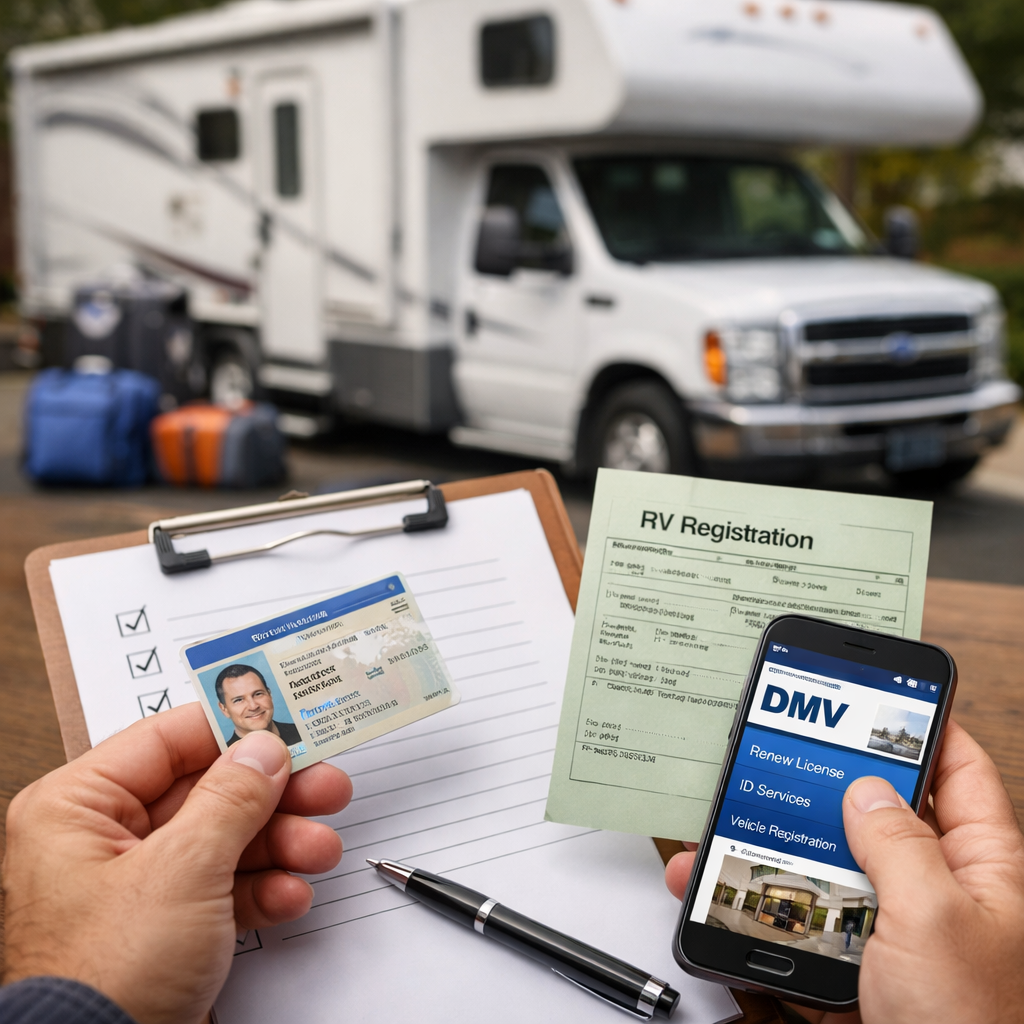
How to Check Your RV License Requirements Before a Big Trip
Before you point a big rig toward the horizon, confirm whether your current driver’s license covers it. Here’s the short version: most drivers can legally operate Class B and Class C motorhomes, plus many mid-size Class A coaches, on a standard license—so long as the vehicle’s gross vehicle weight rating (GVWR) stays under 26,000 pounds. If you tow a heavy trailer or run a long coach, rules tighten quickly. Reciprocity means other states honor your home-state license, but you must still follow their on-the-road restrictions. Use the steps below to check your numbers, match them to state thresholds, and make any non-commercial Class A/B upgrade well before departure, so your trip is both legal and stress-free. RV Critic’s checklists and route-planning guides below help you confirm the right class early.
Quick answer to do I need a special license
In most states, you do not need a special license to drive a typical Class B or Class C motorhome—or many Class A coaches—if the GVWR is under 26,000 pounds. That 26,000 lb rule of thumb covers the majority of RVers, and your home-state license is honored across state lines under reciprocity, though in-state operating rules still apply as you travel (lane use, trailer brakes, towing speeds), as summarized in the RoverPass state guide to RV license requirements (roverpass.com/blog/rv-driver-license-requirements/).
Expect stricter thresholds in heavyweight or long-rig scenarios. Examples:
- California often requires a non-commercial Class A if your trailer GVWR exceeds 10,000 lb; longer housecars can require non-commercial Class B.
- Texas requires non-commercial Class B for a single RV over 26,000 lb GVWR, and non-commercial Class A for combinations over 26,000 lb GCWR.
- Nevada can require a J towing endorsement for trailers over 10,000 lb.
- New York adds an R recreational endorsement for RVs over 26,000 lb, per RVezy’s U.S. overview (rvezy.com/blog/rv-drivers-license-requirements-usa).
Understand the key triggers for special licensing
DMVs lean on manufacturer weight ratings to set license classes:
- GVWR is the maximum safe weight of the motorhome with fuel, water, gear, and passengers included.
- GCWR is the maximum combined weight of the tow vehicle and trailer, set by the vehicle maker. Both terms are used by states to determine if you need a non-commercial upgrade, as summarized in the RoverPass guide above.
Common thresholds that trigger a non-commercial Class A or B (or an endorsement):
- GVWR over 26,000 lb (single vehicle)
- GCWR over 26,000 lb with a trailer over 10,000 lb GVWR
- Trailer GVWR over 10,000 lb (common in California and Nevada)
- Length triggers around 40–45 ft (varies by state)
- Higher passenger capacities in bus-style conversions
Benchmark RV weights to compare against thresholds: typical Class B vans run about 6,000–8,000 lb, Class C motorhomes around 10,000–12,000 lb, and Class A coaches roughly 13,000–30,000 lb, according to Campanda’s national roundup (campanda.com/magazine/rv-special-drivers-license-requirements/).
Trigger-to-requirement cheat sheet:
| Trigger | What it may require | Example states |
|---|---|---|
| GVWR > 26,000 lb (single vehicle) | Non-commercial Class B | Texas; New York (R endorsement) |
| GCWR > 26,000 lb with trailer > 10,000 lb | Non-commercial Class A | Texas; California |
| Trailer GVWR > 10,000 lb | Non-commercial Class A or towing endorsement | California; Nevada (J endorsement) |
| Length > 40–45 ft | Non-commercial Class B or CDL-like path | California (housecar > 40 ft requires upgrade); select states for 45 ft+ |
| High passenger capacity (bus conversions) | Endorsement or higher class | Varies by state |
Step 1: Find your RV’s GVWR and GCWR
Start with your rig’s ratings, not guesses. Check the VIN/chassis label (driver’s door jamb, near the seat base, or in a cabinet), the owner’s manual, the manufacturer’s spec sheet, or use an online VIN lookup. When estimating trip weight, include fuel, propane, water, passengers, pets, gear, and aftermarket add-ons.
Where to find weight specs quickly:
- Owner’s manual or manufacturer brochure
- Chassis/cab label (door jamb or near driver’s seat)
- Build sheet or spec plate inside a cabinet
- Online VIN/spec database from your RV or chassis maker
Curb weight vs. GVWR (quick guide): Curb weight is the vehicle as delivered from the factory with standard equipment and fluids, but no passengers, cargo, or fresh water. GVWR is the absolute maximum allowed weight when fully loaded for travel. Licensing and enforcement are based on GVWR, not curb weight.
Step 2: Check your home state DMV licensing thresholds
Once you know your numbers, compare them to your state’s non-commercial Class A/B rules, exam components, and any towing or air brake endorsements. A high-level, state-by-state summary of RV licensing requirements and common test steps is compiled by Lazydays (lazydays.com/rv-lifestyle/state-by-state-guide-rv-licensing-requirements), but always verify details on your state DMV site.
Concrete examples:
- Texas: Non-commercial Class B for a single RV with GVWR over 26,000 lb; Non-commercial Class A for combinations with GCWR over 26,000 lb and a trailer over 10,000 lb.
- New York: R recreational endorsement when operating an RV over 26,000 lb on a standard license, as noted in RVezy’s U.S. overview linked above.
Upgrade checklist:
- Identify your thresholds (GVWR, GCWR, trailer GVWR, length)
- Confirm the required class or endorsement
- Note written, skills, and vision test elements
- Gather identification, medical/vision documents if needed
- Book testing appointments and budget for fees
Step 3: Map your route and confirm state operational rules
Reciprocity means every state recognizes your valid home-state license, but it doesn’t waive that state’s operating rules—towing speeds, lane use, trailer brake thresholds, and maximum length/height still apply, as explained in the RoverPass guide linked above. If you tow, double-check trailer brake and breakaway requirements; if you’re long or tall, confirm lane restrictions and clearance limits.
Build a quick route worksheet:
| State | Key rule to confirm | Link to statute | Notes |
|---|---|---|---|
| [Add] | Trailer brakes threshold | [Add] | GVWR and breakaway |
| [Add] | Lane restrictions for 3+ lanes | [Add] | Keep right |
| [Add] | Max length/height | [Add] | Watch low-clearance |
Step 4: Determine if you need a non-commercial class or endorsement
Use this logic to pick the right path:
- If your single motorhome’s GVWR exceeds 26,000 lb, several states require a non-commercial Class B.
- If your GCWR exceeds 26,000 lb and the trailer’s GVWR is over 10,000 lb, a non-commercial Class A is common (for example, California’s heavy trailer scenarios).
- If your trailer GVWR is over 10,000 lb but your combo is below 26,001 lb, some states still require an endorsement (Nevada’s J towing endorsement is a typical model).
- Special cases: Washington, D.C. requires a written knowledge test for 26,001 lb+ vehicles; in a few jurisdictions, very long rigs (around 45 ft) can push you toward CDL-like requirements—Campanda notes Wisconsin as a cautionary example.
If your chassis has air brakes, check whether a non-commercial air brake endorsement or restriction applies in your state.
Step 5: Prepare, test, and update paperwork before departure
Expect a straightforward DMV process: a written exam, a basic road/skills test in your rig, and a vision test in many states, per the Lazydays state guide cited above. Schedule early and practice in the exact vehicle-trailer setup you’ll test in.
After upgrading your license class or endorsement:
- Confirm your insurance reflects the correct vehicle class and trailer weights
- Keep proof of registration, insurance, and ID in the rig
- Remember: licensing (your ability to drive) and registration (your vehicle’s legal status) are separate processes, often with different documents and fees
Practical tools and trip-ready tips
- Route and campground tools: RV Critic’s trip-planning primers help you scope routes and stops; RV Trip Wizard can route by your rig’s height and assign dates to stops; Campendium surfaces user reviews for quick site screening, as highlighted in this tools roundup (theworldexplored.com/ultimate-rv-road-trip-planning-tools/).
- Pre-trip safety check (fast pass): Test brakes and lights, confirm hitch and safety chains, set weight distribution and brake controller gain, secure awnings/antennas/steps, and unplug shore power before rolling, echoing Go RVing’s essential checks (gorving.com/tips-inspiration/expert-advice/top-5-essential-rv-pre-trip-checks).
- Build and standards verification: If documentation is unclear, verify build specs and compliance. An RVIA seal indicates the manufacturer complies with adopted industry standards and is subject to 2,000+ unannounced inspections annually (rvia.org/standards-regulations). Common U.S. standards include NFPA 1192 and ANSI A119.5; in Canada, look for CSA Z240/Z241 or an accredited mark such as QAI’s for RVs and trailers (qai.org/rvs-and-trailers/).
RV Critic resources for deeper prep
Newbie Navigator
Start with a beginner RV checklist that clarifies licensing versus registration and core safety basics in plain language: see our full-time RV living checklist for beginners (rvcritic.com/full-time-rv-living-checklist-for-beginners). If you’re still deciding on a rig, compare drivability and towing tradeoffs in our motorhome vs. travel trailer guide (rvcritic.com/motorhome-vs-travel-trailer-9-must-check-factors-for-first-time-renters-to-pick-).
Know your numbers:
- GVWR and GCWR (labels/manual)
- Axle ratings (GAWR)
- Overall length and height (include A/Cs, satellite domes)
- Trailer GVWR and tongue/pin weight
RV Gear Zone
Equip for compliance and control:
- Essentials: proportional brake controller, weight-distribution hitch with sway control, extended tow mirrors, tire pressure monitoring system, and a windshield-height marker.
- Explore hitch and towing options in our RV hitches hub (rvcritic.com/tags/rv-hitches) and add awareness with top-rated security camera systems (rvcritic.com/best-rv-security-camera-systems-to-install).
Quick fitment guide:
| Trailer GVWR | Recommended hitch/brake setup |
|---|---|
| ≤ 7,500 lb | 2" class III/IV receiver, proportional brake controller |
| 7,501–10,000 lb | Weight-distribution hitch with sway control, 2" or 2.5" class IV/V receiver |
| > 10,000 lb | Heavy-duty WDH or 5th-wheel/gooseneck per chassis rating; upgraded brake controller and mirrors |
DIY & Upgrades
Stay test-ready and compliant after modifications:
- Inspect and torque hitch hardware, test trailer brakes and breakaway switch, check all lighting and reflectors
- After any upgrade that adds weight (solar, batteries, cargo boxes), do an after-upgrade weigh-in at a CAT scale and reconfirm GVWR/GCWR limits; update your route’s height and weight parameters
Road Life
Build big-rig confidence:
- Practice tight turns using reference points in an empty lot, set mirrors for blind-spot coverage, and run backing drills with spotter hand signals
- On grades, downshift early, manage speed with engine braking, and maintain extended following distances; observe lane etiquette and right-lane restrictions for longer rigs
- For flexible overnights, learn where and how to find free overnight RV parking (rvcritic.com/how-to-find-free-overnight-rv-parking)
Adventure Stops
Pick destinations that fit your length and height:
- Choose RV-friendly parks with big-rig sites and confirm approach roads for low-clearance hazards
- Try our guide to RV-friendly campgrounds near Yosemite for a taste of big-rig planning in scenic terrain (rvcritic.com/rv-friendly-campgrounds-near-yosemite/)
Frequently asked questions
Do I need a special license to drive a large Class A motorhome?
It depends on weight and length—many states require non-commercial Class B once a motorhome exceeds 26,000 lb, with some adding 40–45 ft length triggers. Use RV Critic’s steps above, then confirm with your home-state DMV.
If my trailer GVWR is over 10,000 pounds, what license might I need?
Several states require a higher class or endorsement when the trailer exceeds 10,000 lb (often non-commercial Class A). RV Critic recommends confirming specifics with your DMV and noting any towing endorsements.
Will states on my route honor my out-of-state license?
Yes—reciprocity applies, but you must still follow each state’s operating rules (lane use, towing speeds, braking). RV Critic’s worksheet above helps you track these before you roll.
Do I need a special license to rent an RV?
Most rentals sit under standard-license thresholds, but confirm GVWR/GCWR. RV Critic advises checking your state’s limits for any needed non-commercial class or endorsement, and international renters should carry an IDP when required.
What happens if I drive without the correct license or endorsement?
You risk fines, being barred from driving the rig, and potential insurance complications. If you’re close to the limits, use RV Critic’s steps to verify with your DMV and upgrade before departure.