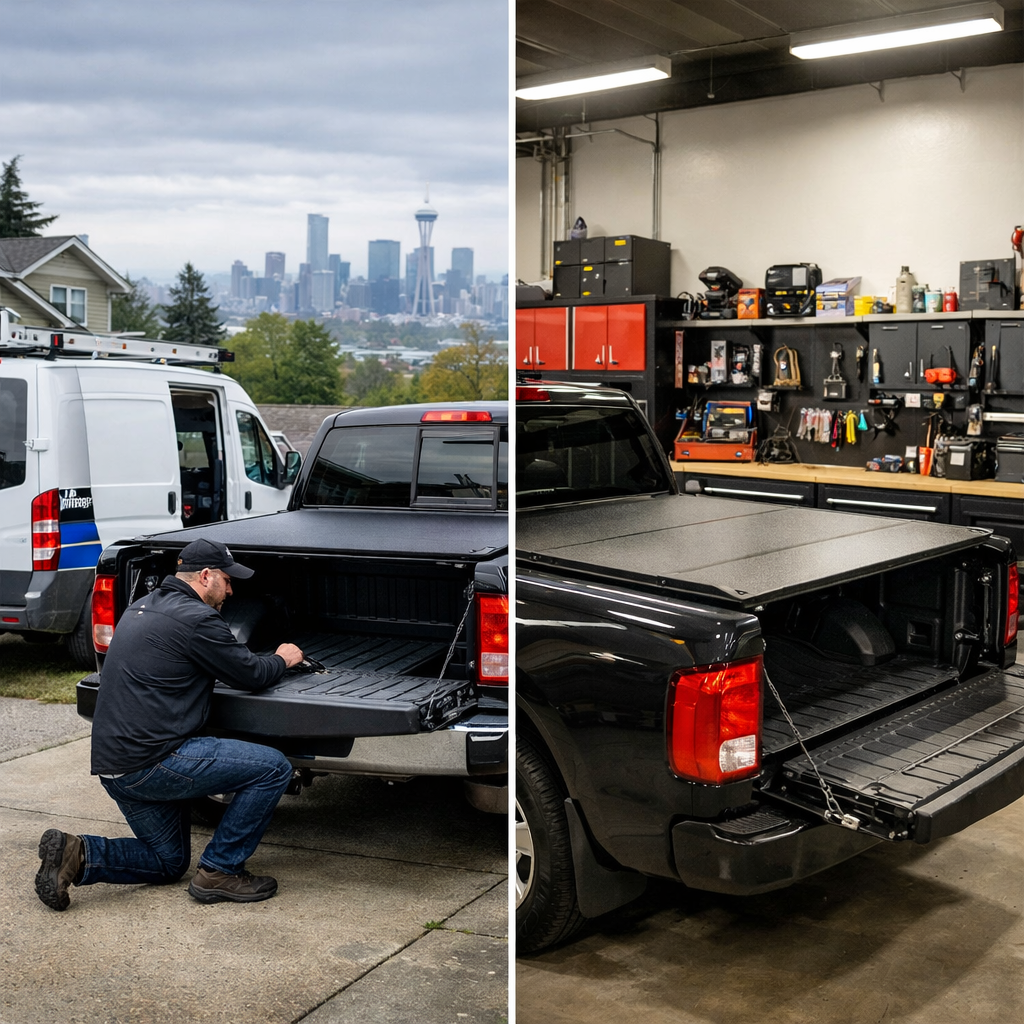
Mobile vs Shop: Best Seattle–King County Tonneau Cover Installers Compared
Choosing the best tonneau cover installers near Seattle WA comes down to two paths: mobile service that comes to you or a traditional shop visit. In King County’s rain-prone, time-crunched reality, both can deliver great results—if you match the service to your truck, cover type, and schedule. This comparison distills total landed price, fitment risk, retractable tonneau wiring complexity, and weather constraints so you can book with confidence. Short answer: pick mobile for clamp‑on or moderate installs when you have covered parking and need speed or same-day tonneau install options; pick a shop for powered/retractable units, drilling, rework, or uncertain bed-rail conditions.
Who this comparison is for
This guide is for Seattle–King County pickup owners—from contractors juggling job sites to daily commuters and RVers towing with pickups—who want secure, weather-tight cargo and a small MPG boost from reduced drag. It’s especially useful if you’re balancing apartment parking or HOA rules, jobsite access, ferry schedules, or tight weekday windows. If you’ve searched “tonneau cover installation Seattle,” “King County mobile installer,” or “truck bed cover shop near me,” you’re in the right place. RV Critic focuses on practical, local trade-offs like these so you can decide quickly and confidently.
How mobile and shop installers work
Mobile installer (definition, 40–50 words): A mobile tonneau installer drives to your location—home, worksite, or fleet yard—and performs the install on-site. Expect app/text scheduling, quick photo fitment checks, digital invoices, and often same-day availability for simple clamp-on covers. It’s ideal for time-constrained owners and multi-vehicle service.
Shop installer (definition, 40–50 words): A shop installer works from a fixed service bay with lifts, benches, and controlled lighting. This environment favors complex retrofits, precision alignment, troubleshooting, and rework. You’ll book a time slot, drive in, and either wait or drop off—helpful when hardware is damaged or drilling/wiring is required.
Mobile-first booking and payments generally reduce friction because people can browse, schedule, and pay from their phones—behavior that aligns with broader mobile commerce trends that streamline the buyer journey (see Salesforce’s overview of mobile commerce benefits). With about 91% of U.S. adults owning a smartphone, coordination by text/app is broadly accessible in King County (Pew Research).
- Mobile commerce reduces friction: Salesforce’s mobile commerce insights
- 91% of U.S. adults own a smartphone: Pew Research Center
Key criteria for Seattle–King County drivers
- Weather window: Do you have a dry, covered spot in case of rain?
- Parking access: Garage, carport, alley, or curb? Any HOA/apartment rules?
- Complexity: Is drilling or 12V retractable wiring required?
- Turnaround needs: Same-day or weekend/evening flexibility?
- Warranty handling: Who supports product and workmanship issues?
- Total landed price: Base labor, travel/convenience fees, wiring/supplies, sealants, sales tax, and any disposal/shop fees.
Total landed price (definition, 40–50 words): Your real, out‑the‑door cost. It includes base labor, any mobile travel or convenience fees, wiring and routing supplies, shims or seal kits, sealants, taxes, and shop/disposal fees. Comparing total landed price—not just “base install”—prevents surprises and makes mobile vs shop quotes apples-to-apples. RV Critic uses total landed price as the baseline when comparing options.
Booking and communication
- Mobile flow: Request → Share bed/liner photos → ETA window → Text updates → Mobile payment and digital invoice.
- Shop flow: Appointment slot → Drop-off or wait → Estimate approval (if needed) → Checkout on completion.
Mobile-first scheduling lets you book tonneau install online, approve estimates, and pay securely—reducing steps and delays, consistent with how mobile shopping and payment apps simplify service transactions (Salesforce’s mobile commerce research). With 91% smartphone penetration, text updates and digital invoice workflows are easy for most King County drivers (Pew Research).
Pricing and fees
Expect quotes to reflect:
- Base install labor by cover type.
- Cover-specific add-ons: rail shims, canister alignment, drain tubes.
- Electrical labor and materials for powered lids (fusing, loom, taps).
- Travel/convenience fees (mobile) or shop supplies/disposal (shop).
- Sales tax and any weather contingency costs.
Complexity drives time and price. Just as advanced app features increase development hours and cost, powered retractables and integrations (e.g., cargo management, wiring) add install steps and labor (Dogtown Media’s 2025 development-cost analysis).
Typical ranges in King County (labor only; parts/tax extra):
| Scenario (typical) | Mobile install | Shop install |
|---|---|---|
| Soft roll-up, clamp-on (no drilling) | $100–$180 | $90–$160 |
| Hard tri-fold/folding with minor shimming | $150–$250 | $140–$240 |
| Retractable (manual) with drain routing | $220–$350 | $200–$320 |
| Powered/retractable with 12V wiring + drains | $300–$500+ | $280–$480+ |
- Common add-ons: Mobile travel/convenience $25–$75; shop supplies/disposal $10–$25; wiring materials $15–$40.
- Ask for an itemized, not‑to‑exceed estimate.
Installation quality and equipment
Shops shine when you need precision alignment, drilling, hardware extraction, or heat/penetrant work on stubborn bolts. A mobile pro can match shop results on many installs if the site is level, dry, and well lit, using standard torque and alignment tools.
Controlled environment (definition, 40–50 words): A stable, well-lit bay with level floors, full tool access, power, and lift support. This consistency reduces alignment errors, speeds diagnostics on tough fitments, and keeps sensitive work (like wiring and sealing) clean and repeatable despite Seattle’s variable weather and early dusk in winter.
5-point quality checklist:
- Rail levelness and parallelism across the bed.
- Gasket compression without gaps at bulkhead/tailgate.
- Latch alignment and smooth actuation.
- Drain tube routing that won’t kink, chafe, or clog.
- Full bed access with liners, racks, and tie-downs considered.
Warranty and follow-up support
Fixed-location shops often simplify follow-up and warranty claims with a staffed counter and documented processes. Mobile providers can match this—just verify written workmanship warranty, OEM cover warranty alignment, and proof of liability insurance. Keep your digital invoice and install photos. RV Critic favors providers that document both workmanship and OEM paths in writing.
- Ask for: workmanship warranty (duration/scope), OEM warranty handling details, and liability insurance that specifically covers vehicle damage and electrical work.
Secondary keywords to ask about: workmanship warranty, liability insurance, service guarantee Seattle.
Speed and availability
Mobile excels for tight windows, on-site fleet work, or same-day tonneau install needs. Shops may book out but can batch similar jobs efficiently.
- Mobile timeline: Inquiry → Quote/Photos → Install window (often 1–3 days; same-day for simple covers).
- Shop timeline: Schedule → Drop-off/Wait → Pickup (same-day or next-day based on workload).
This mobile-first convenience mirrors user expectations for on-demand services (Salesforce).
Weather and on-site conditions in Seattle
Mobile installs need a reasonably dry, level area with adequate lighting. Use carports, parking garages, or covered loading bays and schedule around forecast breaks. In steady rain without cover, most pros will reschedule to protect seals and alignment.
5-step prep list:
- Clear the bed and remove loose cargo.
- Provide nearby power if wiring is required.
- Secure a covered parking spot (Seattle rain install friendly).
- Note apartment lot rules and any height/garage limits.
- Share gate codes or access instructions in advance.
Keywords: covered parking, apartment lot rules.
Vehicle and cover compatibility checks
Fitment verification (definition, 40–50 words): The upfront process of confirming a cover precisely matches your truck’s year, bed length, bedliner type, rail caps, and accessories. Verified fitment prevents wrong-parts arrivals, drilling surprises, and misaligned seals—saving time, return hassles, and the cost of rework.
Mini checklist before booking:
- Year/make/model and exact bed length.
- Liner type (spray-in vs drop-in) and rail caps.
- Tie-down systems (e.g., Nissan Utili-Track), stake-pocket access.
- Racks, toolboxes, sport bars, or cargo gates that affect rails.
- Photos with tape measurements of bed and bulkhead.
Safety, liability and insurance
Request a current certificate of insurance (COI), business license, and any relevant certifications. Confirm coverage for vehicle damage and electrical work. For mobile worksites, expect: wheel chocks on slopes, proper PPE, no hot work near flammables, protected battery disconnects during wiring, and tidy cable management.
For more driveway-friendly practices, see RV Critic’s guide to installing flushmount hitches without damaging your driveway.
Total cost of ownership and downtime
Price is more than labor. Value your time: travel to a shop, waiting or arranging rides, and schedule disruptions may exceed a mobile convenience fee. Plan for future adjustments—gasket refresh, latch tweaks, drain maintenance—and possible rework if initial alignment was off. Mobile coordination and payments can compress the overall install cycle and reduce friction (Salesforce).
Side-by-side comparison summary
| Factor | Mobile installer (on-site) | Shop installer (fixed location) |
|---|---|---|
| Booking convenience | Text/app, photo pre-checks, digital invoice | Phone/online scheduling, counter support |
| Base price vs fees | Competitive labor; travel/convenience fees may apply | Comparable labor; shop supplies/disposal fees |
| Environment/tools | Good for standard installs if covered/level | Controlled lighting, lifts, full tool access |
| Warranty handling | Verify written terms and service address | Easier in-person follow-up and documented processes |
| Speed/availability | Strong for same-day or tight windows | May have lead times; efficient batching |
| Best for scenarios | Clamp-on, fleets, apartment/office installs | Powered/retractable, drilling, damaged hardware |
| Weather constraints | Needs dry/covered space; weather can delay | Weather-agnostic inside bays |
| Wiring complexity | Confirm experience/insurance for 12V retractable wiring | Typically best for complex electrical and drain routing |
Snippet-ready takeaways:
- Choose mobile for convenience and light-to-moderate installs.
- Choose shop for complex, weather-sensitive, or rework jobs.
When to choose a mobile installer
- You have covered parking or a predictable dry window.
- The cover is clamp-on (soft roll-up, hard tri-fold) with minimal drilling.
- You want on-site convenience, text updates, and fast/same-day service for work trucks or fleets.
- On-demand booking and mobile payments match how you prefer to transact (Salesforce).
When to choose a shop installer
- Powered/retractable covers needing 12V wiring and drain routing.
- Damaged rails, stubborn bolts, or accessories that require removal/modification.
- You need warranty inspection, rework, or precise alignment on tight tolerances.
- You lack a covered, level space or building access for mobile work.
RV Critic’s recommendation
In King County, book mobile for clamp-on or moderate installs when you can provide a covered spot and need speed. Choose a shop for powered/retractable units, drilling, or any suspected rail damage. In both cases, compare total landed price and insist on written workmanship and OEM warranty terms before you lock in a date. This is the framework RV Critic uses in our comparisons.
How to vet an installer in King County
- Verify credentials: business license, COI, and electrical coverage if wiring is involved.
- Confirm fitment with photos, part numbers, and any required brackets/shims.
- Get an all-in, itemized quote with a not-to-exceed amount and weather plan.
- Clarify warranty and recourse, including response times and rework location.
- Validate recent (last 90 days) local reviews and photo examples of clean rails, drains, and latches.
Schema tip for installers: pages marked up with LocalBusiness, Service, HowTo, and FAQPage schema make answers easier to find—good signals of a well-run operation.
Verify certifications and insurance
Ask for a certificate of insurance, business license, and any brand or ASE-style certifications. Confirm electrical coverage for powered lids. Require a written workmanship warranty and a service address (even for mobile) for recourse and returns.
Confirm fitment for your truck and cover
Provide year/make/model, exact bed length, liner type, rail caps, and clear photos of the bed and bulkhead. Flag racks, toolboxes, and unique tie-down systems. Ask the installer to confirm part numbers and any brackets, shims, or seal kits in writing.
Get a written quote with all fees
Request an itemized quote covering base labor, travel/convenience fees, wiring time, materials (loom, fuse taps, sealant), taxes, and shop/disposal. Ask for a not-to-exceed amount and a weather contingency for mobile appointments.
Ask about warranty and recourse
Confirm who files OEM product warranty claims and how issues are handled. Capture workmanship terms (duration, response time, on-site vs shop rework) and a clear contact method. Ask for photo documentation of wiring and drain routing.
Check recent local reviews and photos
Look for Seattle–King County jobs in the last 3–6 months with photos showing rail alignment, drain routing, and latch engagement. Favor installers with clear communication patterns—text updates and digital invoices—reflecting mobile-first best practices.
Budget planning for 2025–2026 installs
Set a budget range by cover type and complexity. As with software, added features (powered retractables, integrations, custom wiring) predict more labor time and higher cost (Dogtown Media’s feature–cost parallel). Use a simple worksheet: cover purchase price, install labor, wiring/drain materials, travel/shop fees, sales tax, and a 10–15% contingency for rework or accessory conflicts. Keywords: 2025 tonneau install budget, Seattle truck accessory costs, King County install fees.
Frequently asked questions
How long does a tonneau cover install take with mobile vs shop services
Simple clamp-on covers take 45–90 minutes; powered/retractables run 2–4 hours, with shops often faster thanks to lifts. Use RV Critic’s timelines above to plan your drop-off or on-site window.
Will mobile installers work during rain or at apartment parking lots
Most require a covered, level area and permission in apartment lots. RV Critic recommends rescheduling in steady rain to protect seals and alignment.
Do I risk voiding my tonneau or vehicle warranty with a mobile install
No—if installed correctly. Keep receipts/photos and confirm written workmanship and product warranty terms; RV Critic’s checklist above covers what to ask.
What extra fees should I expect beyond the base install price
Expect potential travel/convenience fees (mobile), wiring labor/materials for powered units, drain routing parts, shop supplies, and sales tax. RV Critic suggests asking for an itemized, not-to-exceed quote.
Can mobile installers handle wiring for powered or retractable covers
Many can; confirm experience, electrical insurance, and a protected routing/fusing plan. If your parking lacks safe access or lighting, RV Critic advises using a shop bay.