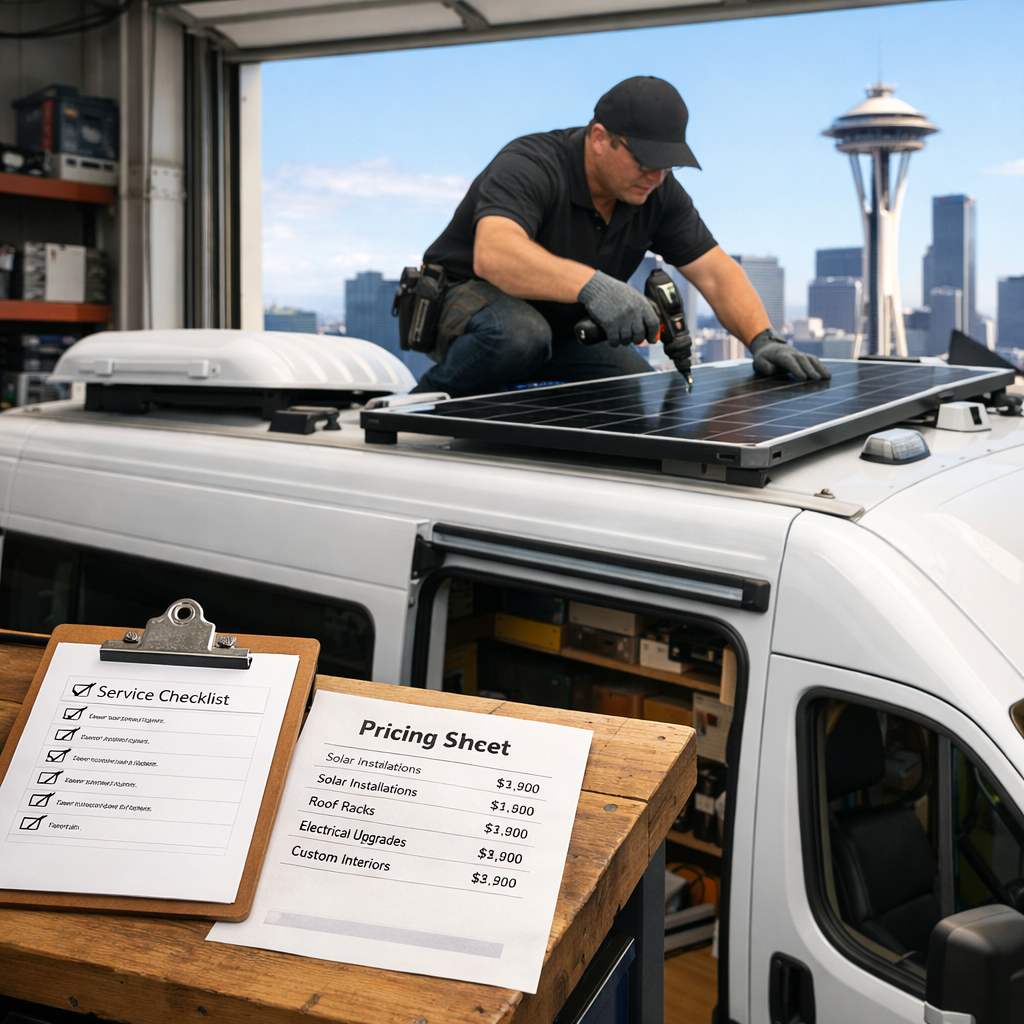
Seattle Fleet Upfitting: Verified Shops, Services, and Pricing Guide 2026
Seattle’s fleet upfitting market is busy and specialized, with options ranging from quick-turn cargo-van packages to custom service bodies and EV-ready builds. If you’re asking where to find trusted fleet vehicle upfitting shops in Seattle, start with OEM-certified networks and NTEA-vetted directories, then compare warranty, lead times, and in-house capabilities before you place a PO. Below you’ll find RV Critic’s verified path to reputable local providers, a clear services matrix, realistic 2026 pricing ranges, and a simple selection checklist geared to light- and medium-duty fleets, including tow and hitch considerations.
Verified Seattle upfitters: how to find and shortlist fast
You can build a reliable shortlist in under an hour using certification networks and category-specific locators that cover Seattle and the Puget Sound:
- Start with RV Critic’s verified Seattle upfitter overview and pricing snapshot to frame your shortlist and budget.
- Start broad with the NTEA Member Directory, which filters by upfitter type, truck bodies, van equipment, and service region, and lists companies with trade association credentials and contacts in the Seattle–Tacoma–Everett corridor (NTEA Member Directory).
- Cross-check with OEM programs. These networks maintain upfit standards and training for local shops: Ford Pro Upfitter Network, GM Upfitter Integration, Ram’s Q-Pro Qualified Upfitters, and Mercedes‑Benz Vans Master Upfitter (Ford Pro Upfitter Network) (GM Upfitter Integration) (Ram Q‑Pro) (Mercedes‑Benz Vans Master Upfitter).
- Validate product-specific distributors for cargo vans: Adrian Steel dealers and Ranger Design dealers often stock shelving, partitions, and ladder racks locally for faster turns (Adrian Steel dealer locator) (Ranger Design dealer locator).
- For truck bodies, use Knapheide’s locator to find regional distributors that install service, platform, and dump bodies in Washington (Knapheide locations).
- For towing and hitches—common with RV support fleets—Torklift Central in Kent is a long-standing Seattle-area installer and custom fabricator for hitches, wiring, and towing accessories (Torklift Central).
- For branding and wraps, search 3M’s Certified Graphics Installer network to identify Seattle shops trained on fleet-grade films and complex installs (3M graphics installer locator).
Fast-turnaround tip: Shops with on-hand van equipment inventory and preconfigured packages can deliver in 3–10 business days once the vehicle is on site. Ask directly about stocked SKUs, same-week install slots, and whether they pre-stage hardware while waiting on vehicle delivery.
What services do Seattle upfitters offer?
Most Seattle-area upfitters cover light- and medium-duty vans and trucks. Expect the following capabilities; ask which are in-house versus outsourced.
- Cargo van interiors: shelving, drawers, partitions/bulkheads, floors, wall liners, ladder/cargo racks
- Electrical and power: inverters (1–3 kW), auxiliary batteries, DC‑DC chargers, shore power, interior LED lighting
- Safety and compliance: cargo securement, backup alarms/cameras, beacons, first-aid and extinguisher mounts; reference FMCSA cargo securement rules for best practice (FMCSA cargo securement)
- Towing/hitches: receiver hitches, brake controllers, 7‑way/4‑pin wiring, weight distribution, tow mirrors
- Truck bodies: service/utility bodies, platform/flatbeds, dump bodies, crane/compressor integration
- Telematics/IT: GPS/ELD devices, camera systems, Wi‑Fi and power management
- Custom fabrication: steel/aluminum welding, brackets, racks, bins, bespoke storage
- Graphics/branding: decals, wraps, DOT numbers, unit ID, safety markings
2026 pricing guide: Seattle fleet upfitting
Install times and labor rates vary by shop, but these are realistic street ranges we see in the Puget Sound market for parts plus install. Complex EV or custom work lands higher.
- Cargo van packages
- Shelving modules (pair): $1,200–$2,400
- Partition/bulkhead: $500–$1,200
- Roof ladder rack (single/double): $900–$2,200
- Floor/wall liners: $700–$1,800
- Interior LED lighting kit: $250–$700
- 1–2 kW inverter + wiring: $1,200–$2,800
- Towing and hitch
- Class III–V receiver + wiring + brake controller: $650–$1,400 installed; heavy-duty and RV towing setups can exceed this (Torklift Central)
- Truck bodies (installed, basic configurations)
- Service/utility body: $18,000–$35,000
- Platform/flatbed: $6,000–$14,000
- Dump body (light/medium duty): $14,000–$30,000
- Telematics/cameras
- Dash/driver cams with install: $350–$900 per unit
- GPS/asset tracking: $200–$450 per unit plus monthly service
- Graphics/branding
- Door logos/ID set (pair): $150–$500
- Partial wrap: $1,200–$2,800
- Full cargo-van wrap: $2,800–$5,500 (3M-certified film shops vary) (3M graphics installer locator)
Budget guardrails:
- Labor in metro Seattle typically lands in the mid-to-high range versus national averages; batch installs (5+ units) reduce per-vehicle cost.
- Lead times and freight can move pricing ±10–20% depending on supply and workload.
How to choose the right Seattle upfitter
- Certifications and fit: Prioritize OEM-affiliated upfitters and those authorized by your preferred equipment brands (Ford Pro Upfitter Network) (Adrian Steel dealer locator).
- Warranty and support: Seek 3-year workmanship or better, written electrical warranties, and local service response times.
- Lead time reality: Ask for a dated slot on the calendar, list of in-stock parts, and a not-to-exceed delivery window; clarify penalties for missed dates.
- EV readiness: Confirm high-voltage safety training, DC‑DC expertise, EV-safe roof mounting, and experience with Seattle-area charging partners (Seattle City Light EV for business).
- Safety/compliance: Ensure installs meet FMCSA securement guidance and OEM body builder guides (FMCSA cargo securement) (GM Upfitter Integration).
- Throughput and QC: Request a sample build sheet, torque logs, electrical schematics, and a photo QC report for each unit.
- Total program cost: Compare vehicle transport, staging, graphics, telematics, rework rates, and post-delivery service—not just the line-item parts.
Warranty and service support
Ask for written terms covering parts and workmanship, how warranty claims are handled, and whether mobile service is available for minor fixes. A strong local bench and access to stocked spares can save weeks of downtime.
Lead times and delivery promises
Have the shop commit to a PO-backed schedule with dependencies (vehicle arrival, parts ETA). For multi‑unit orders, stage hardware ahead of arrival and approve one pilot build to lock specs.
EV readiness and high‑voltage safety
Seattle fleets are accelerating electrification; verify that the upfitter can integrate inverters, DC‑DC chargers, and roof racks without compromising battery systems, and that they coordinate with your facility on AC charging layouts and permits (Seattle City Light EV for business).
The upfitting process: from consultation to handoff
- Discovery: Provide vehicle VINs, payload/towing targets, and use cases; the shop proposes layouts and SKUs with weight and power estimates.
- Quote and pilot: Approve a parts list and a pilot unit; refine placement and ergonomics with your crew lead.
- Ordering and staging: The upfitter orders long‑lead items and pre‑stages stock for faster cycle time once vehicles arrive.
- Installation and QC: Mechanical, electrical, and graphics work proceed with documented checklists; you receive a photo log and torque/electrical test results.
- Handoff and training: Final inspection, inventory of installed equipment, warranty packet, and driver training as needed.
Typical single-van turnaround: 1–3 days for stock packages; 5–10 days for power/telematics; truck bodies vary from 2–6 weeks once the chassis and body are on site.
Vehicle and application fit guide
Use this quick matrix to align gear with jobs and vehicles commonly deployed around Seattle.
| Vehicle/application | Recommended upfit focus | Notes |
|---|---|---|
| Compact cargo vans (Transit Connect, ProMaster City used fleet) | Light shelving, partition, ladder rack, LED lighting | Keep weight low to preserve payload and efficiency. |
| Full-size cargo vans (Transit, ProMaster, Sprinter) | Modular shelving, partition with door, floor/liners, inverter, roof rack | Verify roof load limits, especially on EV variants. |
| Crew vans | Hybrid cargo + seating partitions, under-rack storage | Ensure compliant egress and airbag sensor considerations. |
| Service/utility trucks (pickup/chassis) | Service body, ladder/material rack, bed slides, compressor | Confirm GVWR and axle capacities before spec’ing cranes. |
| Platform/flatbed | Stake racks, tie‑downs, underbody boxes, tow package | Add conspicuity and camera coverage for open loads. |
| Dump body (parks/public works) | Tarping, toolboxes, warning beacons, PTO hydraulics | Standardize controls across units for training. |
| EV vans/trucks | Lightweight racking, DC‑DC charging, telematics, low‑draw lighting | Plan charging locations and cable management early. |
Fleet graphics and branding in Seattle
Coordinate graphics with the upfitter to apply decals or wraps while interiors are being installed. RV Critic recommends fleet-grade films and certified installers for durability and consistent color across orders; 3M’s locator helps you find certified shops in Seattle that meet those standards (3M graphics installer locator). Standardize placement for DOT numbers, unit IDs, and safety markings to speed QC and future reorders.
Quick picks for common RV and light-duty fleet scenarios
These RV Critic quick picks cover common setups and trade-offs.
- Mobile RV service van: Quiet 2 kW inverter with shore power, deep shelving on driver side, partition with window, drop-down ladder rack, LED cargo lighting, Class III hitch and 7‑way wiring (Torklift Central).
- Electric delivery van: Lightweight aluminum shelving, insulated liners, DC‑DC charger for tools, low‑draw LED lighting, telematics and driver cam; plan charging with your facility team (Seattle City Light EV for business).
- Municipal parks truck (3/4‑ton): Service body with top-opening bins, beacon and scene lights, ladder/material rack, Class IV hitch, brake controller, and backup camera integration.
FAQs
What’s the fastest way to verify a Seattle upfitter?
Check RV Critic’s guide, the NTEA Member Directory, and your OEM’s upfitter network, then ask for three recent Seattle references (NTEA Member Directory) (Ford Pro Upfitter Network).
How long does a standard cargo-van upfit take?
Stock packages often finish in 1–3 days; RV Critic sees custom power and telemetry adding about a week.
Do I need a partition in a cargo van?
A partition improves safety and climate control and supports cargo securement best practices (FMCSA cargo securement). RV Critic recommends one for most service vans.
Are EV vans harder to upfit?
They require EV-aware mounting, wiring, and power management, and RV Critic advises choosing an EV-trained shop for comparable timelines.
Where do I source Seattle fleet graphics?
Use a certified installer locator to find shops trained on fleet-grade films and complex wraps (3M graphics installer locator). RV Critic suggests coordinating graphics during the upfit to reduce downtime.