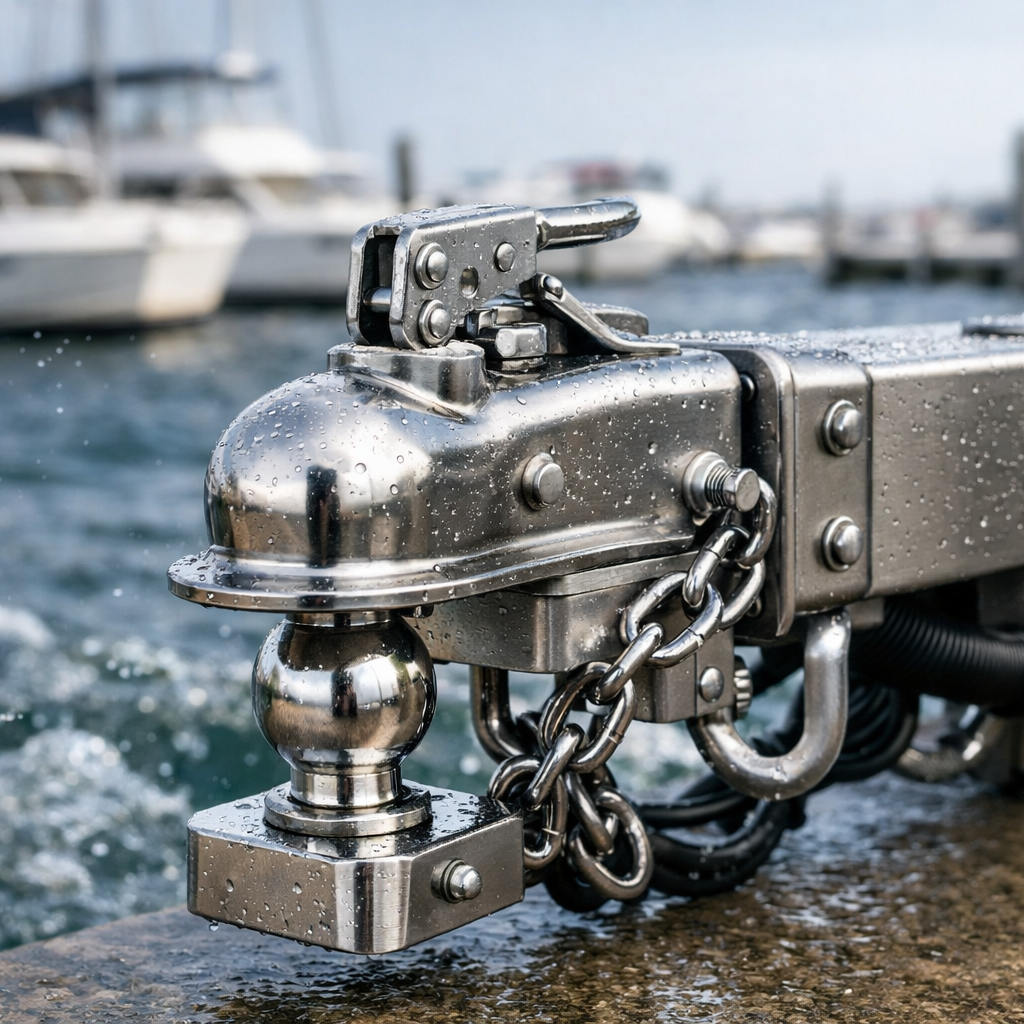
Stainless Steel Trailer Hitches for Saltwater: Avoid Rust, Tow Confidently
Coastal air, boat ramps, and winter road salt can turn a painted hitch into a seized, flaky mess. If you tow near salt, the best stainless steel trailer hitch for saltwater is a stainless receiver paired with a stainless (preferably 316) hitch ball, stainless pins/locks, and an anti-rattle device rated for your hitch class. Stainless won’t just look better longer—it resists the chloride-driven pitting that undermines capacity. Below, we explain why standard coatings fail, when to choose 304 vs 316 stainless, and how to select, install, and maintain a quiet, corrosion-resistant hitch system for Class III–V RV towing. At RV Critic, we favor 316 components at high-wear interfaces (ball and pins) for salt-heavy use.
Why saltwater destroys standard hitches
Salt accelerates rust on conventional painted or zinc-plated steel. Receiver hitches live low under the bumper, where gravel chips coatings and road spray drives chlorides into crevices. Over time, mounts can seize inside the receiver, turning a simple ball-mount swap into a grinder-and-torch ordeal—along with real safety and serviceability risks, especially in winter salt regions and after beach use (see rust prevention guidance from The Rust Store on stuck mounts and salt exposure).
Electrochemical corrosion definition (40–50 words): Electrochemical corrosion is a chemical reaction where metal atoms lose electrons in the presence of water and salts, forming rust and pits. Chlorides from road salt or seawater penetrate coatings and crevices, creating localized cells that accelerate metal loss at stress points and hidden joints.
High‑risk scenarios:
- Surf or brackish launches and beach camping
- Ferry mist and coastal highway spray
- Winter road salt and slush
- Storing with the ball mount left in the receiver
For stainless alternatives and performance claims over painted steel, see stainless EcoHitch guidance noting superior rust resistance and towing performance versus conventional hitches.
How stainless steel prevents rust and failure
Stainless steel contains at least 10.5% chromium; that chromium forms a thin, self-healing oxide “passive layer” on the surface that shuts down rust formation and resists pitting in harsh environments, as summarized in this stainless steel hitch guide. In ocean conditions, 304 stainless typically corrodes less than 0.0001 inches per year, while regular carbon steel can corrode more than 100 times faster—translating to decades of service with far less upkeep in coastal use. Properly engineered stainless receivers meet or exceed towing ratings; for example, EcoHitch stainless receivers are marketed with higher tongue and tow capacities than some conventional painted hitches (verify labels and manuals).
304 vs 316 stainless for coastal towing
Quick take: 304 offers excellent all-around corrosion resistance for road spray and occasional coastal trips. 316—often called marine-grade—adds molybdenum for superior chloride pitting resistance and is the better pick for direct saltwater exposure, boat ramps, and polished marine hardware settings, per Suncor’s stainless marine hardware guidance.
When is 304 “good enough”? If your hitch sees mostly inland travel with occasional coastal spray or ferry crossings, 304’s extremely low corrosion rate already delivers a multi‑year advantage with basic rinsing. Choose 316 when you launch boats frequently, store near ocean air, or tow daily along salted shore roads. RV Critic’s rule of thumb: default to 316 for parts that see the most salt contact (hitch ball, pins/locks).
Comparison table (rows = decision factors):
| Decision factor | 304 Stainless (excellent general resistance) | 316 Stainless (enhanced chloride resistance) |
|---|---|---|
| Use cases | Inland + occasional coastal spray, ferry mist, winter salt with rinsing | Frequent ocean launches, brackish immersion, daily coastal towing, polished visible hardware |
| Components | Receivers, most ball mounts, stainless pins/locks | Hitch balls, pins/locks, receivers and mounts where offered, visible hardware |
| Maintenance cadence | Rinse after salt; protect quarterly in coastal season | Rinse after salt; protect quarterly or monthly with frequent immersion |
What to buy: receivers, ball mounts, and hitch balls for saltwater
Build a corrosion-resistant hitch stack that matches your vehicle’s rating and travel patterns:
- Receiver: stainless receiver hitch—304 for mixed inland/coastal; 316 where offered for heavy salt exposure.
- Ball and mount: 316 stainless hitch ball; stainless ball mount, or an aluminum ball mount paired with a stainless ball for weight savings.
- Pins/locks: stainless hitch pin, lock, and coupler lock. Marine-oriented suppliers like Suncor list stainless locks, latches, and U-bolts suitable for saltwater use.
- Accessories: stainless or coated anti-rattle hitch device; rubber receiver plug to keep spray and sand out when idle.
RV Critic quick picks by common RV towing classes:
- Class III (2-inch): 5,000–8,000 lb GTW typical; choose 2-inch shank mounts, 1-inch ball shank for 2-inch ball, rise/drop to level trailer, and ensure sway/weight-distribution compatibility if needed.
- Class IV (2-inch heavy duty): 8,000–10,000+ lb GTW; confirm W/D compatibility, step up to 2-5/16-inch ball as trailer weight dictates.
- Class V (2.5-inch): 12,000–18,000+ lb GTW; use 2.5-inch shank mounts or a rated reducer sleeve; match 2-5/16-inch ball and ensure every accessory equals or exceeds Class V ratings.
Good/Better/Best builds:
- Good: 304 stainless receiver + stainless ball + stainless pin.
- Better: 304 receiver + 316 ball + anti-rattle device + receiver plug.
- Best: 316 receiver and ball + anti-rattle + stainless locks + seasonal corrosion protectant.
Load ratings and hitch class compatibility
Stainless construction does not inherently reduce towing capacity. Match receiver class (III–V) and Gross Trailer Weight (GTW)/Tongue Weight (TW) to your vehicle’s published limits and the labels on each component. Some stainless models claim higher ratings than painted units—always verify the lowest-rated component governs.
RV Critic spec table template (fill before purchase/install):
| Spec item | Your value/notes |
|---|---|
| Vehicle tow rating (GTW) | |
| Tongue weight limit (TW) | |
| Hitch class and receiver size | |
| Weight-distribution (W/D) compatible? | |
| Ball size and shank diameter | |
| Ball mount rise/drop needed | |
| Accessory ratings (pin, lock, anti-rattle) |
Tongue weight definition (40–50 words): Tongue weight (TW) is the downward force the trailer exerts on the hitch; it’s typically 10–15% of Gross Trailer Weight (GTW). Both TW and GTW must be within the lowest-rated component’s limits to maintain safe handling, braking, and stability on the road.
Installation and anti-rattle fitment
- Dry-fit the receiver, ball mount, and accessories; torque fasteners and the hitch ball to spec with a calibrated wrench.
- Lightly protect the inside of the receiver and contact points; apply a thin film of corrosion inhibitor, and lightly lube hitch pins to prevent galling without attracting grit (best practices echoed in stainless EcoHitch guidance).
- Choose an anti-rattle device that matches or exceeds your hitch class: U-bolt clamp styles, internal wedges, or threaded pins. Prefer stainless or quality coated hardware.
Micro‑checklist before first tow:
- Confirm bumper, spare-tire, and tailgate clearance at full articulation.
- Route wiring away from pinch points/edges; secure with clips.
- Re-torque ball and hardware after the first loaded trip.
- Test fit with your loaded trailer to ensure level stance and quiet operation.
Maintenance to keep stainless rust-free
RV Critic flow to follow after any salt exposure:
- Rinse with fresh water (receiver, mount, ball, pins).
- Wash with mild soap; avoid harsh abrasives that can scratch the passive layer.
- Dry thoroughly.
- Apply a light rust‑preventative spray on contact points and inside the receiver.
- Lightly lube pins and the hitch ball/coupler interface.
- Insert a receiver plug when not in use.
Cadence: Rinse after each salt encounter; reapply protectant before winter and quarterly if you tow frequently in coastal conditions, consistent with Patriot Hitches maintenance tips and stainless EcoHitch care guidance. Store mounts dry and covered; removing the ball mount prevents pressure fits and reduces trapped moisture.
Cost and long-term value
Stainless is a lifecycle investment. With 304 corroding under 0.0001 inches per year in ocean conditions and 316 resisting chloride pitting even better, you’ll spend less time repainting, avoid seized hardware, and preserve appearance and resale. Freed-up service time matters—stuck mounts and rust remediation add real labor and downtime, as detailed in guidance on how to prevent rust on receiver hitches.
ROI snapshot for coastal use:
| Factor | Coated carbon steel | 304 stainless | 316 stainless |
|---|---|---|---|
| Upfront cost | Low | Medium | High |
| Repainting/maintenance | High (annual touch-ups) | Low (rinse + periodic protectant) | Low (rinse + periodic protectant) |
| Stuck‑mount downtime risk | High | Low | Lowest |
| Replacement frequency | 3–5 years typical | 8–15+ years | 10–20+ years |
Safety checks and inspection cadence
Set a routine (RV Critic baseline):
- Pre‑trip quick check every tow.
- Monthly detailed check during salt season.
- Seasonal torque verification and deep clean.
Seven-point checklist:
- Surface condition (pitting, crevice corrosion, cracks).
- Tightness/torque of receiver bolts and hitch ball.
- Accessory fit: no binding; remove the mount periodically.
- Anti‑rattle integrity and hardware condition.
- Wiring abrasion and secure routing.
- Safety chain mount condition and clip security.
- Coupler/ball lubrication and clean latch action.
Apply a thin protective coat inside the receiver after inspections to prevent pressure fits.
Alternatives when full stainless isn’t available
- Use an aluminum ball mount with a 316 stainless hitch ball and stainless pins/locks.
- Select a high-zinc or e‑coat receiver and step up your wash-and-protect routine.
- Upgrade key interfaces (locks, U-bolts, safety hardware) with marine-grade stainless from suppliers like Suncor.
Reinforce maintenance: rinse immediately after salt, reapply protectant before winter and quarterly in coastal seasons, use receiver plugs/hitch covers when idle. Avoid abrasive pads or steel wool that can damage stainless passive layers and invite corrosion, as noted in stainless steel hitch guidance.
Frequently asked questions
Do stainless steel hitches eliminate rust entirely?
No. Stainless dramatically reduces rust and pitting, but RV Critic still recommends rinsing after salt exposure and using light protectant to keep interfaces moving freely and looking new.
Is 304 stainless good enough near the coast, or do I need 316?
For occasional coastal spray and winter salt, 304 is typically sufficient; RV Critic suggests 316 for frequent ocean launches or daily salt exposure due to better chloride pitting resistance.
How often should I rinse and lube a hitch after salt exposure?
Rinse with fresh water after each salt encounter, dry thoroughly, and apply a light protectant to contact points—RV Critic’s baseline routine. Reapply protectant before winter and quarterly if you tow often in coastal conditions.
Will a stainless hitch change my tow rating?
No. Properly engineered stainless receivers meet the same ratings; RV Critic’s rule is to abide by the lowest-rated component and your vehicle’s published limits.
What should I do if my ball mount seizes in the receiver?
Prevent it: remove mounts regularly, keep the receiver interior lightly protected, and use a plug when idle—RV Critic’s prevention list. If stuck, avoid brute force that could damage parts; use penetrating tactics and focus on prevention going forward.
References cited inline:
- Stainless EcoHitch guidance (torkliftcentral.com)
- Stainless steel hitch guide (evparts4x4.com)
- Suncor stainless marine hardware (suncorstainless.com)
- Prevent rust on receiver hitches (theruststore.com)
- Patriot Hitches maintenance tips (patriothitches.com)