Top-Rated Helper Springs to Reduce Sag Towing Fifth-Wheel Trailers
Upgrading your truck’s rear suspension is one of the most effective ways to keep a fifth wheel level and stable. The best helper springs reduce rear squat from pin weight, sharpen steering and braking feel, and calm sway and porpoising so you can tow with confidence. At RV Critic, we favor solutions that add control without unnecessary maintenance or complexity. Below, we break down the leading helper systems—what they do, how they differ, and which kits shine for consistent heavy loads versus mixed-use daily driving. If you’re asking whether there are top-rated helper spring kits for towing fifth wheels, the short list includes progressive rubber springs (like Timbren SES), coil-tension systems (Road Active Suspension), quick-engage overload stabilizers (Torklift StableLoad), airbags for maximum adjustability, and budget-friendly leaf-assist packs.
What helper springs do for fifth-wheel towing
Helper springs are add-on supports that increase rear spring rate and load support to counter a fifth-wheel’s pin weight, keeping the truck level and composed. Benefits include reduced squat, better stability, and less fore-aft bounce. As one manufacturer notes, “Rubber helper springs can enhance braking and steering responsiveness while towing” (see Timbren’s 5th‑wheel towing guidance).
A heavy pin can unload the front axle, dulling steering and lengthening stops while inviting sway and porpoising over dips. Properly matched helper springs counter rear squat, restore front-axle loading, and improve sway control and stability—key to safer fifth‑wheel towing.
Helper spring types explained
There are two main helper-spring families—coil-tension systems and hollow rubber helper springs—with airbags and quick-engage stabilizers serving distinct niches.
Hollow-rubber progressive springs (40–50 words): These progressive-rate elastomer bump-stop replacements compress under load and stiffen as weight increases. The rising-rate behavior resists sag and reduces sway and porpoising with no air lines or regular service. They engage naturally as the rear settles and are essentially maintenance-free for set-and-forget stability.
Coil-tension/variable-rate mechanical systems (40–50 words): Bolt-on coil-tension units preload and brace the leaf-pack, converting it into an active, variable-rate system. They stay largely idle when unloaded, then add force as weight is applied. The result is strong sag control, improved stability, and minimal impact on empty-ride comfort, with user-adjustable tension at install.
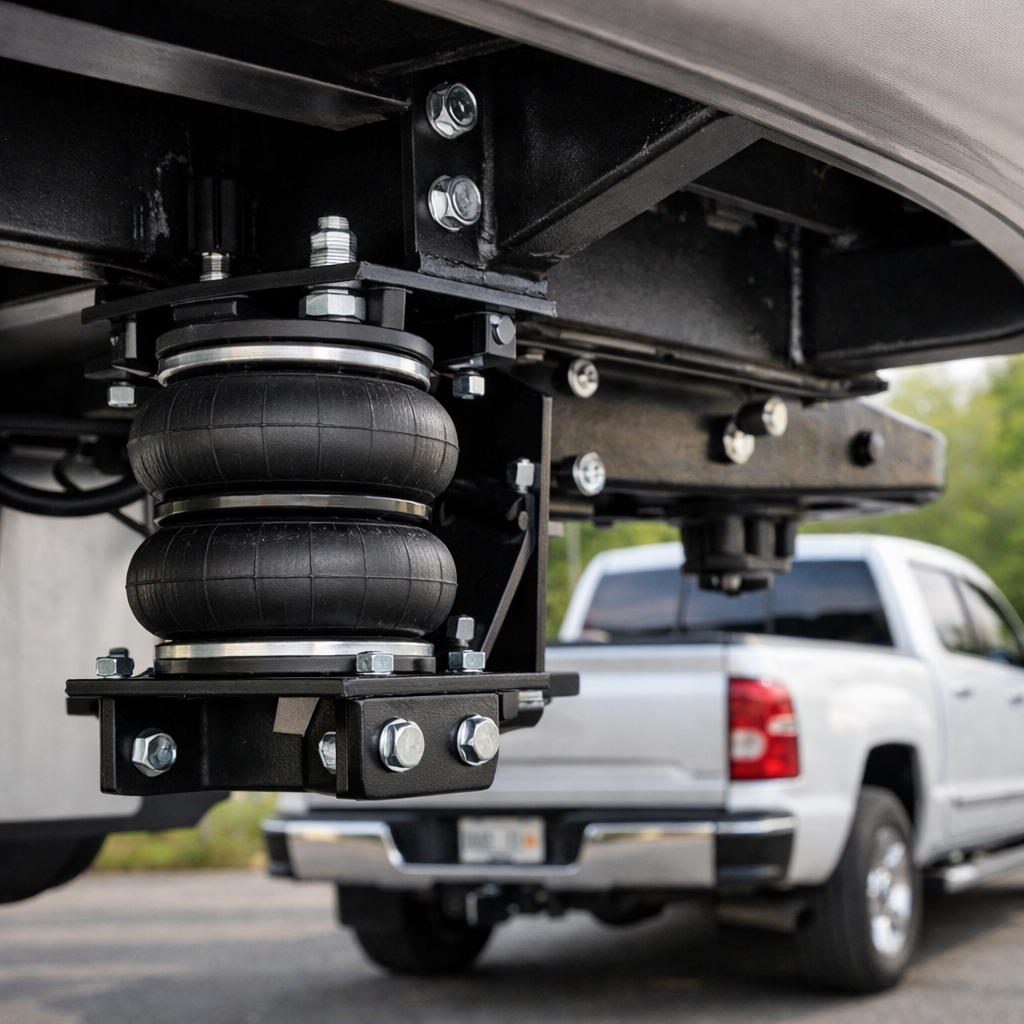
Air springs (airbags) (40–50 words): Frame-to-axle air bladders inflate to raise ride height and balance load. They deliver the widest adjustability for changing payloads and easy left/right leveling, but add complexity: brackets, lines, inflation valves or an onboard compressor, plus periodic leak checks and pressure management to maintain performance.
Quick-engage stabilizers (40–50 words): These devices close the gap to factory overload leaves so support comes in immediately under load. By eliminating delayed contact, they reduce initial sag, sway, body roll, and porpoising. Most include simple on/off engagement for daily driving versus towing days and require little ongoing attention.
Comparison snapshot:
| Type | Engagement (unloaded vs. loaded) | Adjustability | Maintenance | Best use scenario |
|---|---|---|---|---|
| Hollow rubber (progressive) | Minimal when empty; ramps with load | Set-and-forget | None (periodic torque checks) | Consistent heavy pin weight; simple reliability |
| Coil-tension (variable-rate) | Largely idle empty; adds force under load | Tension set at install; fine-tune later | Low (occasional checks) | Mixed-use towing; improved control without airbags |
| Air springs (airbags) | Driver-controlled via PSI | Highest (on-the-fly) | Moderate (leaks/pressure) | Frequently changing payloads; precise leveling |
| Quick-engage overload stabilizers | Off when disengaged; instant when on | On/off engagement | Low | Daily driver that tows on weekends; quick control |
How to choose the right helper system for your truck and fifth wheel
Confirm pin weight and payload. Weigh your rig and aim to maintain level ride height without exceeding payload capacity, GVWR, or GAWR.
Determine your use pattern. Consistent heavy towing needs stable, maintenance-free support; variable loads benefit from adjustability.
Match the solution. Progressive rubber springs provide no-maintenance squat and sway reduction. Coil-tension systems remain neutral unloaded and curb porpoising under load. Airbags deliver the widest on-the-fly adjustability but add compressors/lines and upkeep. RV Critic’s rule of thumb: choose the simplest option that keeps your ride height, leveling, and steering feel where you need them.
Top-rated helper spring kits for fifth-wheel towing
- Timbren SES – Progressive hollow rubber; maintenance-free stability that improves ride quality and reduces rear sag. See details in Timbren SES.
- Road Active Suspension (RAS) – Variable-rate coil system; documented 3.75-inch sag reduction and near-elimination of porpoising with long-term reliability. See details in Road Active Suspension.
- Torklift StableLoad – On/off pre-load of overload leaves; reduces sag, sway, roll, and porpoising with quick engagement. See details in Torklift StableLoad.
- Airbag systems – Highest adjustability and leveling for varying payloads; requires plumbing and periodic maintenance. See details in Airbag systems.
- SumoSprings – Elastomer supports that many owners report reduce sway and improve handling; lighter-duty feel than heavy progressive designs. See details in SumoSprings.
Pros, cons, and best-for:
| System | Type | Pros | Cons | Best for |
|---|---|---|---|---|
| Timbren SES | Progressive rubber | No maintenance; simple install; stable under load | Firmer feel on big bumps when unloaded | Consistent heavy pin weight; set-and-forget |
| Road Active Suspension | Coil-tension variable-rate | Strong sag/porpoising control; neutral unloaded | Install tension needs dialing; cost | Mixed-use daily driver + regular fifth-wheel |
| Torklift StableLoad | Quick-engage stabilizer | On/off control; body roll reduction | Less fine adjustability than airbags | Trucks alternating between work and weekends |
| Airbags | Air bladders | Max adjustability; left/right leveling | Complexity, potential leaks, upkeep | Frequently changing payloads and bed loads |
| SumoSprings | Elastomer supports | Sway reduction; easy install | Lighter-duty feel on very heavy pin weights | Moderate pin weights; comfort-focused tweak |
Timbren SES
Timbren SES uses hollow Aeon rubber springs with a progressive spring rate that increases resistance as load rises, absorbing shock and curbing sag, sway, and porpoising without air or periodic service. That simplicity translates into an easy DIY suspension upgrade that improves ride quality and helps the truck stay composed under fifth-wheel pin weight. As detailed in the Timbren SES overview, “Adding hollow rubber springs can lengthen the life of factory leaf springs by reducing stress.” RV Critic values this low-maintenance design for trucks that see consistent fifth‑wheel duty.
Road Active Suspension
Road Active Suspension (RAS) adds coil tension to your leaf pack, turning it into an active, adjustable, variable-rate system that’s mostly idle when empty and progressively engages as weight is applied. In third-party testing, installers recorded about 3.75 inches of sag reduction, virtually eliminated bounce/porpoising, a no-drill install, and flawless performance reported over 20,000+ miles of fifth‑wheel towing (see RV Enthusiast testing). RV Critic appreciates its neutral unloaded behavior for daily drivers that also tow.
Simple RAS tuning checklist:
- Set initial coil tension per instructions.
- Tow your fifth wheel on a known route.
- Recheck ride height and bounce; add or release tension in small increments.
- Verify steering feel and headlight aim at night.
- Re-torque after your first shakedown trip.
Torklift StableLoad
StableLoad is a quick-engage stabilizer that closes the gap to your factory overload springs so support arrives instantly under load—reducing sag, sway, body roll, and porpoising. Many applications offer fast on/off control from the bedrail; some install without drilling and select kits carry lifetime coverage (see Torklift’s guidance). It’s a smart option if you want a mostly stock unloaded ride during the week and stable towing on the weekend. For mixed-use trucks, RV Critic sees the quick engage/disengage as a practical advantage.
Airbag systems
Airbags are inflatable bladders mounted between the frame and axle that you pressurize to set ride height and balance load. They excel at variable loads and left/right leveling, especially with an onboard air compressor and in-cab controls. The tradeoff is added complexity—brackets, air lines, valves—and periodic leak checks and pressure management. If you tow frequently, RV Critic considers an onboard compressor and in‑cab controls worthwhile.
Mini pros/cons:
- Pros: Maximum adjustability and leveling; compensates for changing payloads and side-to-side weight.
- Cons: Vulnerable to puncture or leaks; limited inherent sway control unless paired with other supports.
Hellwig helper springs
Leaf-assist helper spring packs bolt onto your existing leaf springs to add preload and resist sag. Think of them as a budget-friendly, set-and-forget overload assist for predictable, moderate fifth‑wheel pin weights. You can dial initial preload with U-bolts at install. They’re best when your truck–trailer pairing and payloads don’t vary much. RV Critic views them as a cost-conscious option when loads are predictable.
SumoSprings
SumoSprings are elastomer-style supports similar in concept to progressive rubber springs, but often tuned softer. Owners report reduced side-to-side sway and improved handling on RVs and trucks, with some noting increased front-end bounce on rough roads when paired with very stiff shocks (see RV Love’s owner report). Consider them a lighter-duty elastomer option for moderate pin weights—a comfort-leaning choice in RV Critic’s view.
Installation, tuning, and maintenance basics
Category checklists:
- Elastomer (Timbren/Sumo): Bolt-on in place of bump stops; set recommended clearance; no routine maintenance; RV Critic recommends rechecking fastener torque after initial miles.
- RAS: No drilling/welding; set initial coil tension; road-test with your fifth wheel; fine-tune tension and recheck after a shakedown tow.
- StableLoad: Engage for towing, disengage for daily driving; some kits are no-drill; verify clearance around overloads.
- Airbags: Mount brackets, route air lines away from heat and chafe, leak-check with soapy water; plan for an onboard compressor and cab controls if you tow frequently.
5-step tuning flow:
- Measure unloaded ride height at the rear fender.
- Hitch the fifth wheel on level ground.
- Measure sag and note steering feel/headlight aim.
- Adjust helper (tension, air pressure, or engagement).
- Road-test, remeasure, and repeat until level and stable.
Real-world performance factors to validate before you buy
- Look for documented sag reduction and porpoising control (e.g., RAS demonstrations show ~3.75 inches less sag with bounce virtually eliminated).
- Match engagement behavior to your load: progressive rubber (always ready), mechanical variable-rate (engages with weight), airbags (driver-adjusted), or on/off stabilizers.
- Confirm fitment: clearance around bump stops/overloads, drilling needs, and compatibility with your hitch, bed accessories, and exhaust routing.
RV Critic recommends tracking your results on a known route: before/after ride height, steering effort, braking feel, headlight aim at night, and crosswind or passing-truck sway response.
Safety, payload, and warranty considerations
RV Critic reminder: Helper springs do not increase tow rating or payload; they redistribute and supplement support to maintain ride height and stability. You must remain within GVWR, GAWR, hitch, and tire ratings. Document your install and torque values and keep OEM parts for warranty clarity. Some products advertise lifetime warranties on select applications—verify details before purchase.
Frequently asked questions
Do helper springs increase my truck’s tow rating or payload?
No—helper springs improve leveling and stability but don’t change factory ratings. RV Critic recommends staying within GVWR/GAWR and your hitch and tire limits.
Which helper system best controls sag and sway with a heavy fifth-wheel pin weight?
Progressive rubber or mechanical variable-rate systems excel for consistent heavy pin weights, while airbags suit varying loads. RV Critic suggests prioritizing options with documented sag and sway control on your truck.
Will helper springs change my unloaded ride quality?
Many systems remain neutral when unloaded—RAS largely idles off‑load, and StableLoad can be disengaged. RV Critic notes elastomer bump stops may feel firmer only over larger bumps.
Can I install helper springs myself or do I need a shop?
Many kits are DIY-friendly with hand tools, but airbags and some leaf-assist systems take more time. RV Critic advises a shop install if routing air lines or setting tension feels outside your comfort zone.
Are airbags better than rubber or mechanical helper springs for variable loads?
Yes—airbags offer the most on-the-fly adjustability for changing payloads. RV Critic sees rubber or mechanical systems as lower-maintenance, set-and-forget alternatives.